The Neurobiology of Brow Healing: Why Some Tattoos Itch, Others Don't, and What Scabbing Really Means
During the healing phase of a cosmetic eyebrow procedure, two questions frequently arise from clients: "Why are my brows itching so much?" and conversely, "Why am I not itching or scabbing at all - did the pigment fail to take?"
As a former Medical Radiation Therapist, I look at the healing process through a cellular and neurobiological lens. Itching and scabbing are not random occurrences; they are direct biological markers of your skin’s inflammatory cascade and the level of mechanical trauma inflicted during the session.
Here is the scientific breakdown of why some people experience the dreaded "healing itch," why others enjoy a scab-free recovery, and how Nano Brows offer a fundamentally superior biological healing path compared to traditional microblading.
1. The Neurobiology of the "Healing Itch"
When skin undergoes a cosmetic procedure, the body initiates a precise four-stage wound-healing process: Hemostasis, Inflammation, Proliferation, and Remodeling.
The sensation of itching (pruritus) and subtle "tingling" that typically occurs between days 3 and 7 post-procedure is driven by three main physiological factors:
Histamine Release and Cytokines: During the proliferative phase, immune cells (such as mast cells) release histamines and pro-inflammatory cytokines into the local tissue. Histamine binds to H1 receptors on nearby nerve endings, sending mild "itch" signals to the brain.
Nerve Regeneration (Re-innervation): Micro-trauma disrupts the delicate sensory nerve endings (nociceptors) located in the upper dermis. As the tissue heals, these nerve endings regenerate and re-establish signaling networks—a process guided by Nerve Growth Factor (NGF). This temporary neural hypersensitivity manifests as a light, "yib-yib" tingling sensation.
Epidermal Contraction: As new keratinocyte cells migrate to close the skin barrier, the drying epidermis contracts. This mechanical tension pulls on surface nerve endings, amplifying the urge to scratch.
Clinical Verdict: Mild itching and tingling are active signals of healthy tissue regeneration and neural recovery.
2. Microblading vs. Nano Brows: Mechanical Trauma and Scabbing
Why do some clients suffer from heavy, itchy scabs while others experience virtually no scabbing at all? It comes down to the structural mechanics of the technique used.
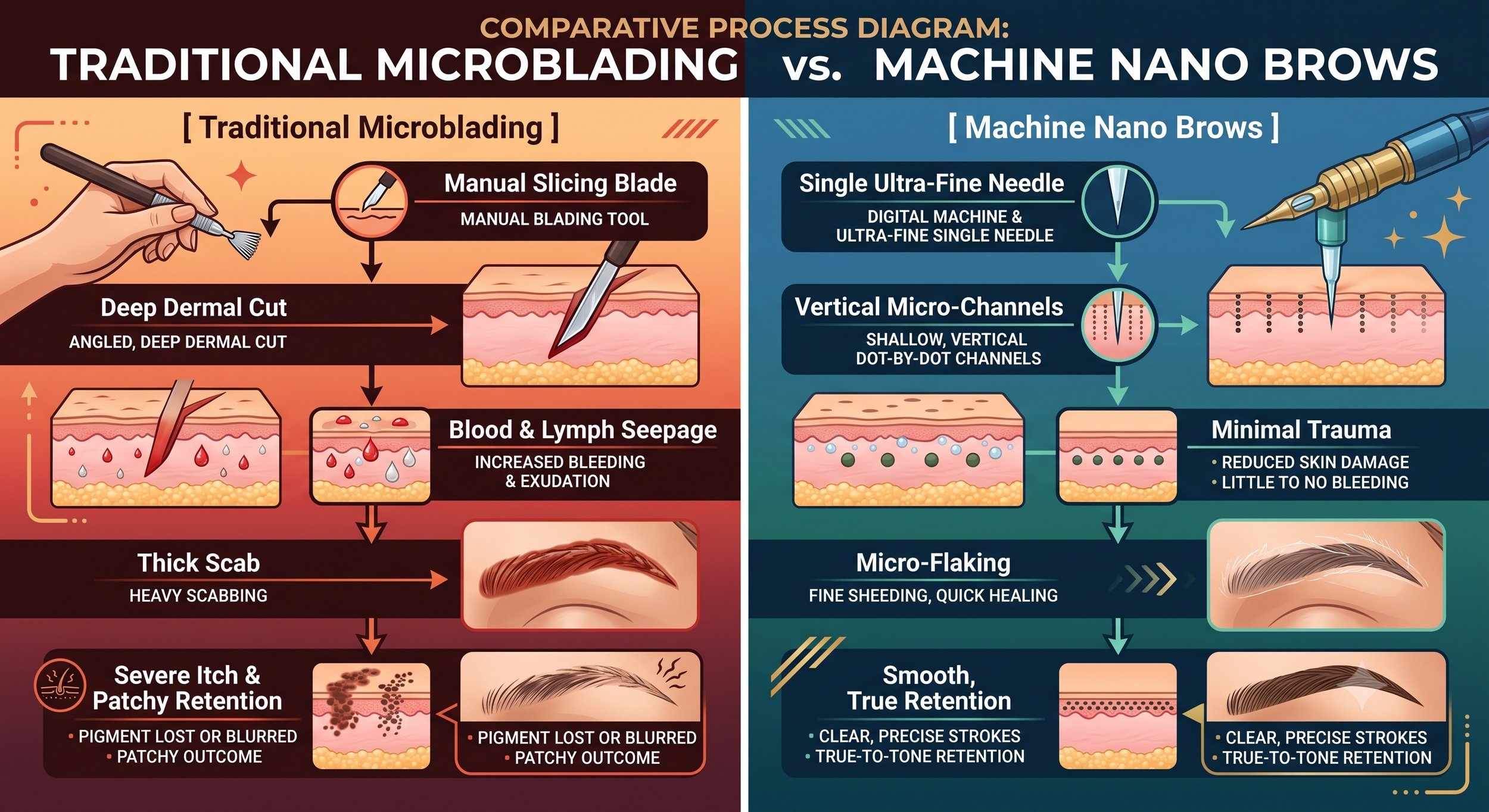
Traditional Microblading: The High-Trauma Path
Microblading utilises a manual hand tool containing a row of grouped needles that literally slice horizontally through the epidermis and into the dermis.
Thick Scabbing: Cutting into the dermis severs microscopic blood vessels, causing blood and lymphatic fluid to pool on the skin's surface. As this fluid dries, it forms a thick, dense scab (crust).
Patchy Retention: As heavy scabs naturally contract and fall off, they often pull the encapsulated pigment particles out with them. This results in patchy, inconsistent color retention that requires aggressive touch-ups.
Intense Itching: The combination of heavy dermal trauma, high histamine release, and tight, pulling scabs triggers severe itching, increasing the risk of accidental scratching and post-inflammatory hyperpigmentation or scarring.
Nano Brows: The Precision Engineering Alternative
Nano Brows utilise an advanced digital motor and a single, ultra-fine needle to deposit pigment into the upper dermis (papillary dermis) through clean, vertical micro-channels without slicing the skin.
No Blood, No Heavy Scabs: Because single-needle precision avoids severing dermal blood vessels, there is negligible blood or lymph seepage. Without dried fluid, thick scabs simply cannot form.
Micro-Flaking: Instead of crusting, the skin undergoes a subtle, almost invisible process of micro-flaking (natural epidermal turnover).
Consistent Color Lock: Without heavy scabs to "pull" the pigment out, the skin barrier closes smoothly over 24 to 48 hours, locking the pigment stably into the dermal matrix.
3. "I Didn't Itch or Scab at All—Did It Work?"
If a client experiences no scabbing, minimal itching, and doesn't even feel the need to apply aftercare ointment, it is natural to worry that the needle was "too shallow." However, in modern technical PMU, this is the ultimate sign of mastery.
If the needle were truly too shallow (epidermis only): The pigment would simply wash away or shed completely within 7–14 days as cells renew.
If the technique is precise (upper dermis with minimal trauma): The skin closes rapidly with minimal histamine release. The absence of heavy scabbing means you don't experience the severe mechanical pulling that causes intense itching.
At URADIANT, when our clients report a completely smooth, itch-free heal with zero scabbing, it confirms that our single-needle machine control achieved the exact target depth—delivering maximum pigment retention with minimal biological disruption.
Clinical Aftercare Protocol for Itchy Skin
If you do experience mild neural tingling or itching during days 3–7:
Never Scratch or Pick: Scratching disrupts the delicate re-epithelialization phase and can pull pigment out of the dermis or introduce secondary bacterial infections.
Gently Pat the Area: Lightly tapping the surrounding skin disrupts the itch-signal transmission along the sensory nerve without damaging the tissue.
Keep it Hydrated: A micro-thin layer of sterile, recommended aftercare ointment reduces epidermal tension, soothing surface nerves without suffocating the skin.
Scientific References
Baranska, A., et al. (2018).Unveiling skin macrophage dynamics explains tattoo persistence.Journal of Experimental Medicine, 215(4), 1115–1133. (Details dermal tissue recovery and pigment encapsulation).
Oaklander, A. L. (2011).The neurobiology of itch and healing in cutaneous trauma.Dermatologic Clinics, 29(2), 161–168. (Explains nerve regeneration, nociceptor sensitivity, and pruritus during dermal repair).
Zhen, X., et al. (2020).The effects of needle insertion parameters on skin injury and wound closure.Journal of the Mechanical Behavior of Biomedical Materials, 103, 103588. (Demonstrates the difference between vertical micro-punctures vs. horizontal slicing trauma).
Holman, D. M., & Kalaaji, A. N. (2006).Cytokines and histamine signaling in dermatological wound healing.Journal of Drugs in Dermatology, 5(7), 610–615.
[ Explore our rituals : Nano Brows, Lip Blush & Dark Lip Neutralisation, SMP]
URADIANT SYDNEY | Visit our sanctuary, The Alchemy of Light, Art and Transformation
110D Boundary Street, Paddington NSW 2021. [Link: Get Directions]