The Ultimate Guide to Permanent Brows: Comparing Techniques, Longevity, and Skin Conservation
Navigating the world of cosmetic tattooing (PMU) can feel overwhelming. With terms like Microblading, Ombré, Combination Brows, Nano Brows, and Nano Blading thrown around on social media, clients are often left confused about which technique truly suits their skin type and lifestyle.
As a former Medical Radiation Therapist, I look at cosmetic tattooing through a strict clinical lens. Every stroke or shaded pixel is an interaction with living tissue. Choosing the right technique isn't just about how brows look on day one—it's about how the pigment ages within your skin over five to ten years.
Below is an expert, science-backed comparison of Australia's four primary eyebrow techniques, followed by the truth behind one of the industry's biggest marketing mix-ups.
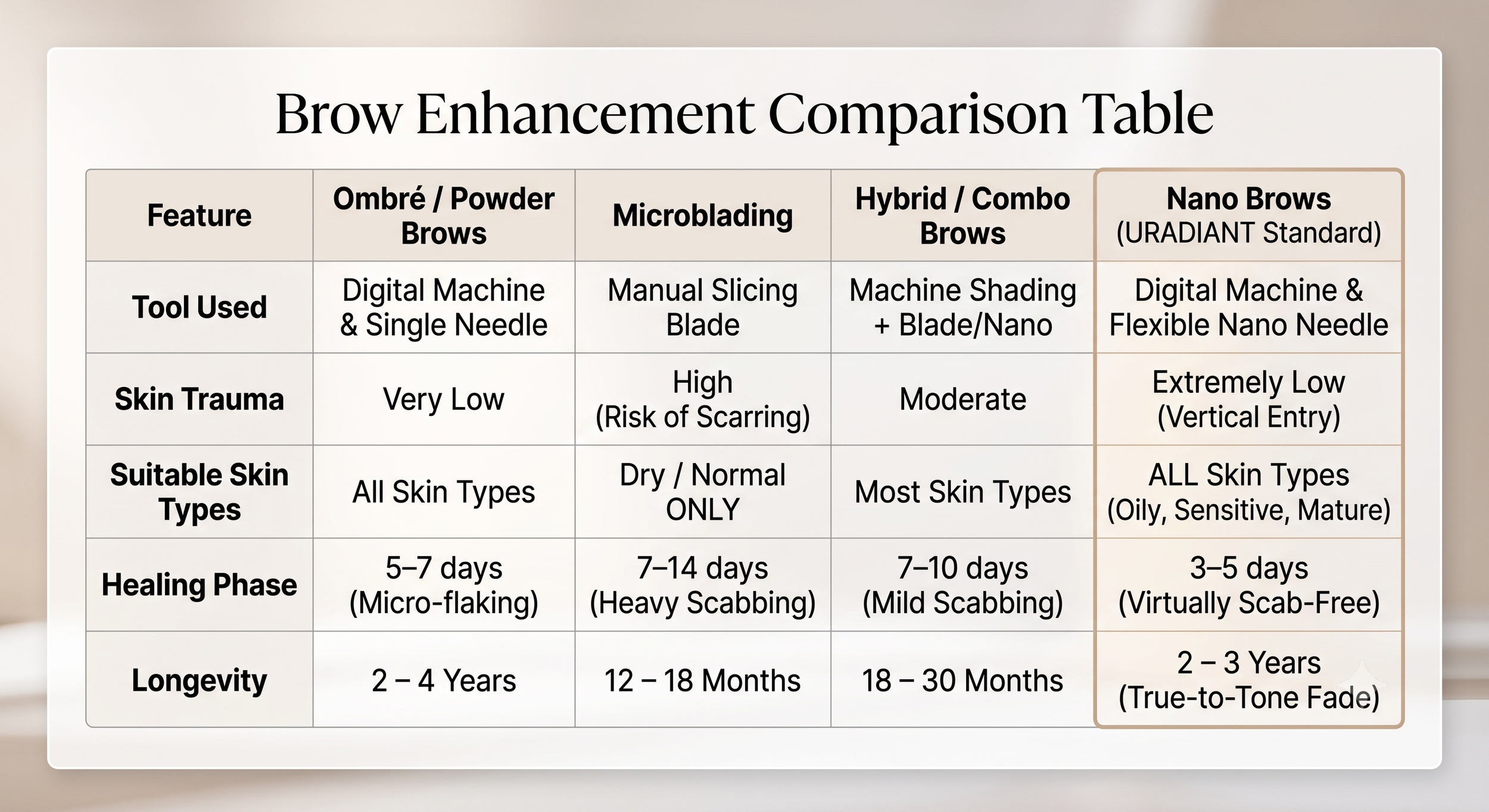
Technical Comparison of Eyebrow Tattooing Methods
1. Ombré / Powder Brows
The Method: Performed using a digital PMU machine and a single micro-needle oscillating at high speed. It deposits tiny, pixelated dots of pigment into the skin, creating a soft, misty background reminiscent of brow powder. "Ombré" specifically refers to a gradient design—lighter at the front and gradually darkening towards the arch and tail.
Time Taken: 1.5 to 2.5 hours.
Longevity: 2 to 4 years (The longest-lasting technique).
Style & Finish: Soft, filled-in, and structured—ranging from a sheer "watercolor" wash to a bolder makeup look.
Pros: Excellent retention on all skin types (especially oily, porous, or mature skin). Extremely gentle on tissue with minimal scabbing.
Cons: Lacks individual hair-stroke definition; may appear too "filled-in" for clients seeking an ultra-realistic, bare-skin look.
2. Traditional Microblading
The Method: A manual, non-mechanical technique. The artist uses a handheld tool fitted with a row of tiny needles forming a blade. This blade is drawn manually across the skin to create fine, horizontal incisions (micro-cuts) where pigment is deposited.
Time Taken: 1.5 to 2 hours.
Longevity: 12 to 18 months.
Style & Finish: Crisp, individual hair strokes designed to mimic natural growth.
Pros: Offers a quick, realistic transformation for clients with virgin, normal-to-dry skin.
Cons: High risk of dermal trauma, scarring, and pigment blurring over time. Not suitable for oily, thin, or mature skin. Slicing the skin severs micro-blood vessels, leading to heavier scabbing, painful healing, and potential colour shifts to salmon pink or cold ash.
3. Hybrid / Combination Brows
The Method: A dual approach combining machine-drawn or manual hair strokes at the head of the brow with soft machine shading through the body and tail.
Time Taken: 2 to 2.5 hours.
Longevity: 18 to 30 months.
Style & Finish: Textured yet defined—providing both realistic front strokes and three-dimensional depth in areas with sparse natural hair.
Pros: Highly customizable. Great for clients who want the realism of strokes with the longevity and density of powder shading.
Cons: Longer procedure time. If the hairstrokes are created using manual microblading blades, the front strokes still carry a risk of scarring or blurring over time.
4. Machine Nano Brows (The Modern Gold Standard)
The Method: Uses a digital device with a single, ultra-fine needle (often 0.23mm–0.35mm) that vibrates rapidly. Instead of slicing, the needle enters the skin vertically, puncturing microscopic dots that form hyper-realistic, flexible hair strokes.
Time Taken: 2.5 to 3.5 hours (Requires extreme artist precision).
Longevity: 2 to 3 years.
Style & Finish: Hyper-realistic, multidimensional hair strokes that move seamlessly with natural hair growth.
Pros:Universal skin compatibility (works beautifully on oily, sensitive, or mature skin). Minimal pain, zero bleeding, and fast micro-flaking healing rather than heavy scabbing. Zero risk of slice scarring, ensuring pigment stays crisp and fades true to tone.
Cons: Requires advanced technical mastery from the artist and a higher initial investment.
Quick Reference Summary Table
Industry Myth Buster: Nano Brows vs. "Nano Blading"—Are They the Same?
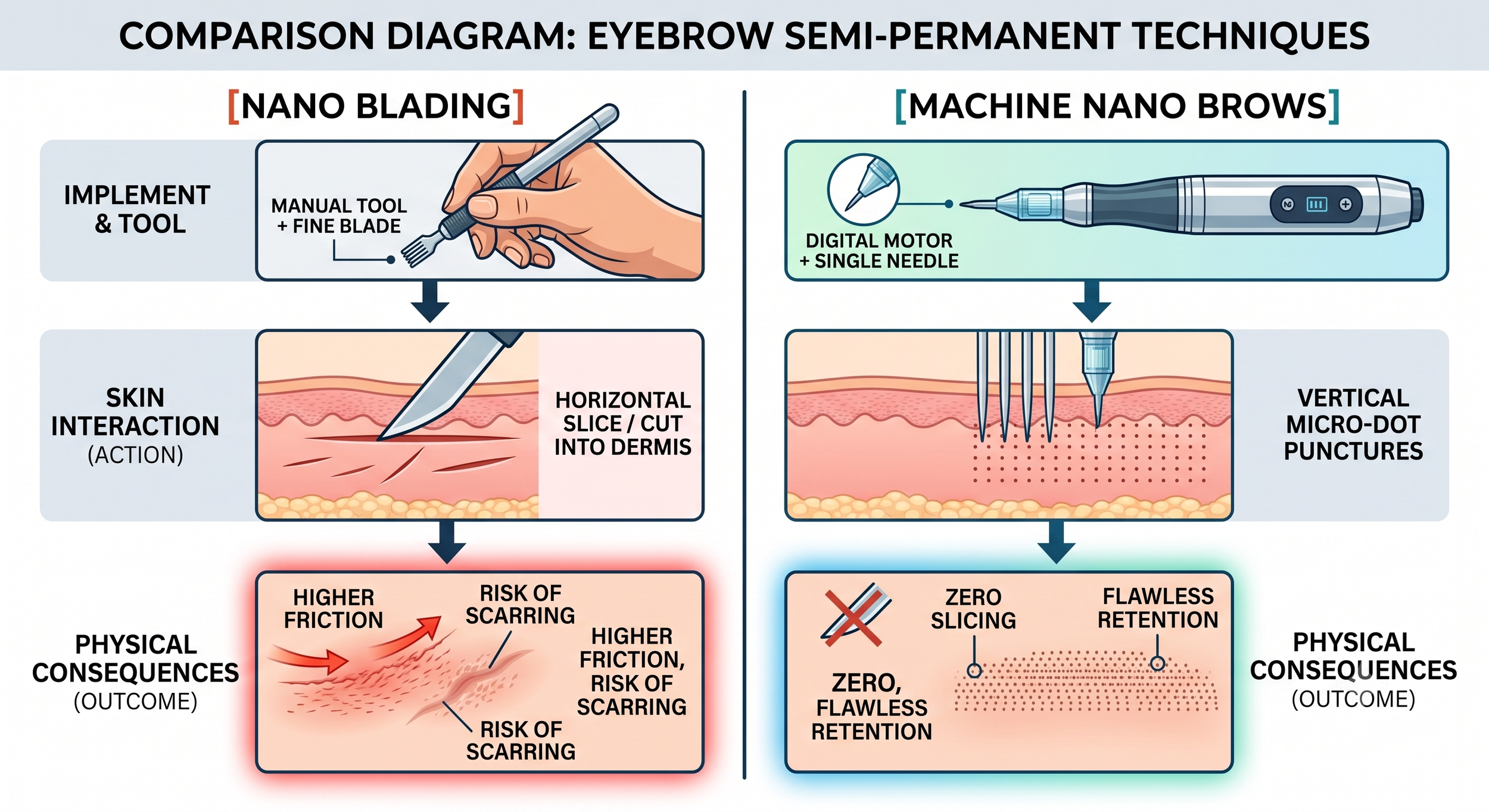
One of the most frequent points of confusion among Australian clients is the difference between Nano Brows and Nano Blading. Many marketing campaigns use these terms interchangeably, but from a clinical standpoint, they are fundamentally different techniques.
1. Nano Blading (Manual Cutting)
What it actually is: "Nano blading" is simply traditional microblading performed with a slightly smaller or thinner manual blade.
How it works: Despite the word "nano," it is still a manual slicing action. The artist drags a row of micro-needles across the skin to carve physical cuts.
The Result: While the strokes may appear thinner on day one, the mechanical slicing action carries the exact same risks as microblading—micro-scarring, uneven pigment burial, and eventual blurring on oily skin.
2. Machine Nano Brows (The URADIANT Way)
What it actually is: A machine-led, single-needle technique with zero blading or slicing involved.
How it works: An acoustic digital motor drives a single ultra-fine needle up and down in rapid, vertical oscillations. It deposits microscopic dots of high-purity pigment cleanly into the upper dermis without tearing surface tissue.
The Result: Hyper-realistic, 3D strokes that age predictably. Because there is no horizontal tearing, the skin heals smoothly without fibrotic scar tissue.
The URADIANT Commitment: Why We Champion Machine Nano Brows
In Australian permanent makeup, client safety and long-term skin health must come first. Traditional microblading was a pioneering step for the industry years ago, but modern tissue science has proven that manual slicing can compromise dermal integrity over time.
At URADIANT, we have completely elevated our practice to Machine Nano Brows. By combining single-needle precision with our background in Medical Radiation Therapy, we offer a technical standard that respects your anatomy:
Zero Skin Trauma: We preserve your dermal structure, making the treatment suitable even for thin, sensitive, or mature skin.
True-to-Tone Longevity: Using high-grade European-certified Hybrid pigments alongside machine control prevents colour shifts to unwanted red, grey, or blue tones.
Flawless Healing: Experience a virtually scab-free healing phase with no interruption to your lifestyle.
Whether you are seeking full, fluffy hairstrokes or a delicate partial restoration, Nano Brows represent the safest, most refined, and long-lasting choice for your face.
Scientific References & Reading List
Baranska, A., et al. (2018). Unveiling skin macrophage dynamics explains tattoo persistence. Journal of Experimental Medicine, 215(4), 1115–1133. (Details dermal tissue recovery and pigment encapsulation).
Zhen, X., et al. (2020). The effects of needle insertion parameters on skin injury and wound closure. Journal of the Mechanical Behavior of Biomedical Materials, 103, 103588. (Demonstrates mechanical differences between vertical micro-punctures vs. horizontal slicing trauma).
Dirks, M. (2017). Modern Pigment Formulations and Chemical Regulations (REACH) in Permanent Beauty Applications. Archives of Dermatological Research, 309(6), 481–489. (Explains modern hybrid pigment safety and uniform fading).
Serup, J., & Sepehri, S. (2015). Tattoo Pigments: Chemistry, Toxicology and Photochemical Fate in the Skin.Current Problems in Dermatology, 48, 28–35.
[ Explore our rituals : Nano Brows, Lip Blush & Dark Lip Neutralisation, SMP]
URADIANT SYDNEY | Visit our sanctuary, The Alchemy of Light, Art and Transformation
110D Boundary Street, Paddington NSW 2021. [Link: Get Directions]