The Molecular Science of PMU Pigments: Organic, Inorganic, and Hybrid Formulations for Nano Brows
In the world of cosmetic tattooing, achieving long-lasting, realistic results goes far beyond technique - it relies heavily on the chemistry of the pigments implanted into the dermis. As a former Medical Radiation Therapist, I look at pigments through a molecular lens. Understanding particle size, molecular weight, and oxidative stability is the key to predicting how a pigment behaves beneath your skin over time.
When it comes to Nano Brows, clients and artists alike often debate the choice between Organic, Inorganic, and Hybrid pigments. Here is the scientific breakdown of how these formulations interact with your skin's immune system, the truth about safety, and why URADIANT strictly utilises advanced Hybrid pigments.
What Are Cosmetic Tattoo Pigments Made Of?
At a fundamental chemical level, tattoo pigments are divided based on their carbon chemistry and elemental origins:
1. Inorganic Pigments
Chemical Composition: Manufactured primarily from mineral and metal oxides, such as Iron Oxides (Fe2O3), Titanium Dioxide (TiO2), and Chromium Oxide.
Particle Structure: Inorganic molecules have a high molecular weight and significantly larger particle sizes (ranging from 1.0 to 2.0 microns).
Skin Interaction: Because of their high density and larger particle size, they reflect light with a softer, matte finish. However, because they are lower in tinting strength, more pigment load is required to achieve rich colour.
2. Organic Pigments
Chemical Composition: Synthetic, carbon-based ring structures (such as Azo dyes, Phthalocyanines, and Quinacridones). Note: "Organic" in pigment chemistry refers to carbon bonds, not "all-natural" or botanical ingredients.
Particle Structure: Organic pigments possess a low molecular weight and exceptionally small particle sizes (often 0.1 to 0.5 microns).
Skin Interaction: Their small size gives them ultra-high tinting strength, producing vibrant, intense hues that resist fading for years.
The Myth Debunked: Are Inorganic Pigments "Unsafe"?
There is a widespread misconception in the beauty industry that inorganic pigments are "toxic" or "unsafe" because they contain metal oxides. This is scientifically untrue.
Medical Purity: Cosmetic-grade inorganic Iron Oxides undergo rigorous synthesis and purification to ensure they are biocompatible, non-reactive, and free from heavy metal contaminants.
Immune Acceptance: Iron oxides are naturally recognised and tolerated well by human tissue. In fact, because iron is a natural element within human hemoglobin, the body’s immune response to purified iron oxide is extraordinarily mild.
Safety Reality: Organic pigments, while brilliant in tone, actually carry a slightly higher risk of allergic contact dermatitis due to their complex synthetic carbon-ring structures. Therefore, synthesized inorganic oxides remain among the safest, most stable minerals used in dermatological cosmetics.
Molecular Weight, Dermis Stabilisation, and Macrophage Retention
When a Nano Brow needle implants pigment into the upper dermis, a complex biological reaction takes place:
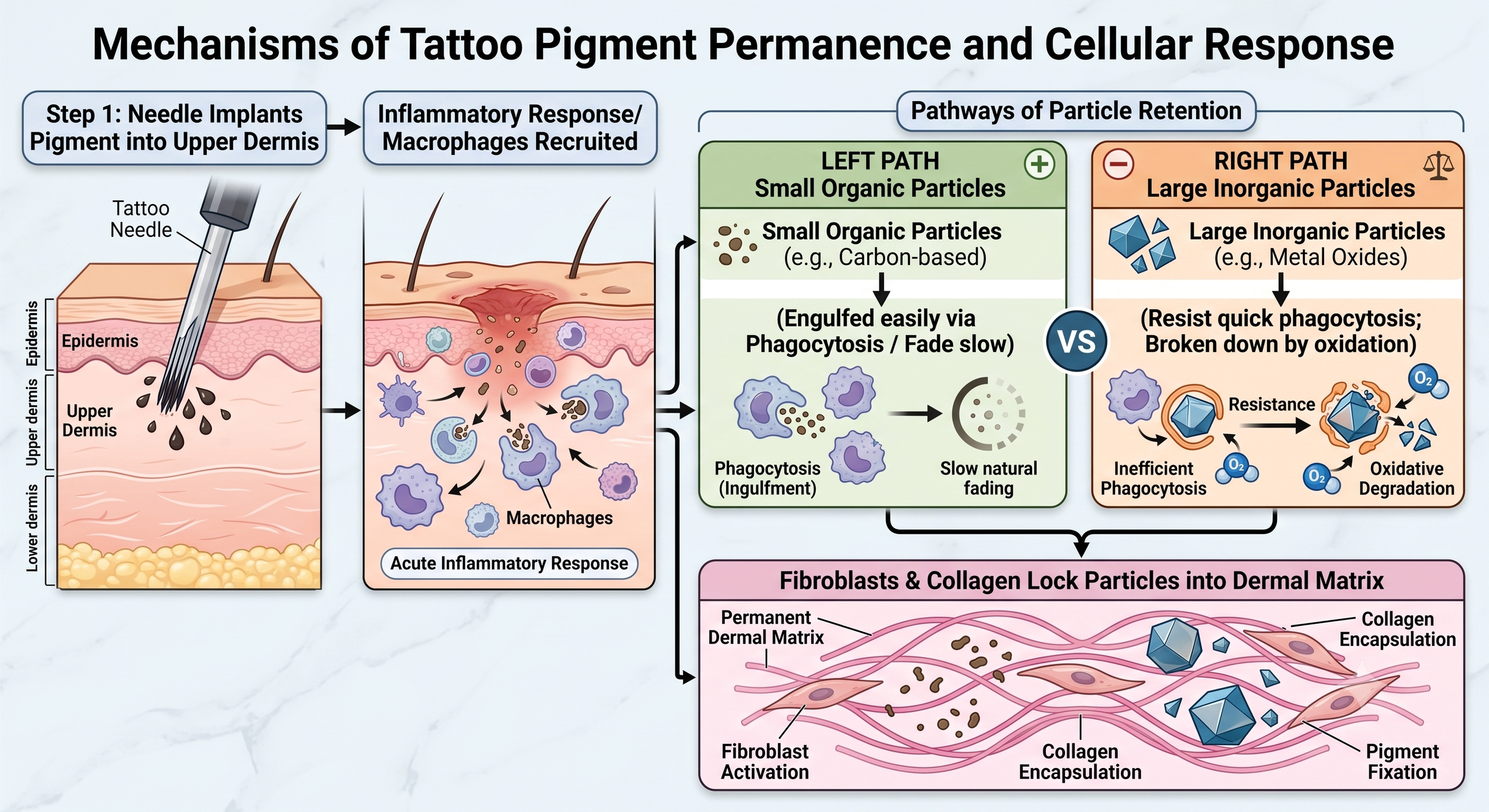
Phagocytosis: Specialized white blood cells called macrophages arrive to clear foreign matter.
Particle Size Retention: If a pigment particle is too small, macrophages engulf it easily via phagocytosis and carry it into the lymphatic system. If the particle is too large, macrophages cannot digest it, forcing the body to encapsulate the pigment in a network of collagen fibres and fibroblasts in the dermal matrix.
The Molecular Tug-of-War:
Organic particles are small and hydrophobic; once encapsulated, they remain intensely stable against cellular removal, offering long retention (3–5+ years).
Inorganic particles are heavier and softer; over time, natural metabolic processes break down the iron bonds, leading to faster fading (1–2 years).
Pigment Oxidation and Colour Shift (Red vs. Grey)
Why do traditional brow tattoos turn bright red, salmon pink, or dull slate grey? It comes down to Pigment Oxidation.
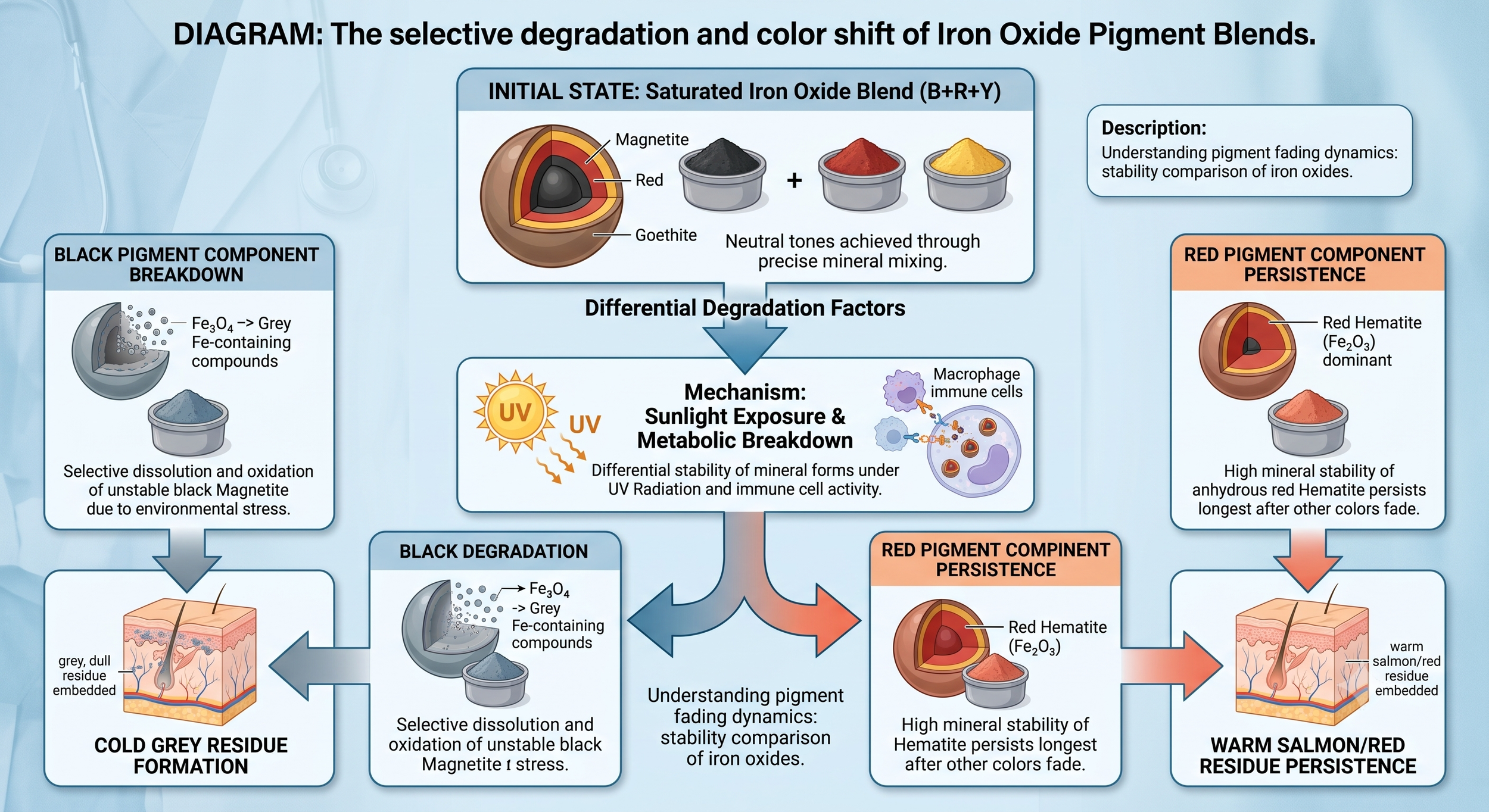
A brown pigment is never a single molecule; it is a blend of Black, Red, and Yellow particles:
Inorganic Iron Oxide Blends: Black iron oxide breaks down and oxidizes much faster than Red iron oxide under UV light. Once the black and yellow particles degrade, the stubborn Red Iron Oxide remains trapped in the skin, turning the brow an unwanted salmon pink.
Low-Quality Carbon Blends: Conversely, if unstable carbon black is mixed poorly, the warm tones fade first, leaving behind a cold, blue-grey residue.
Comparison: Organic vs. Inorganic vs. Hybrid
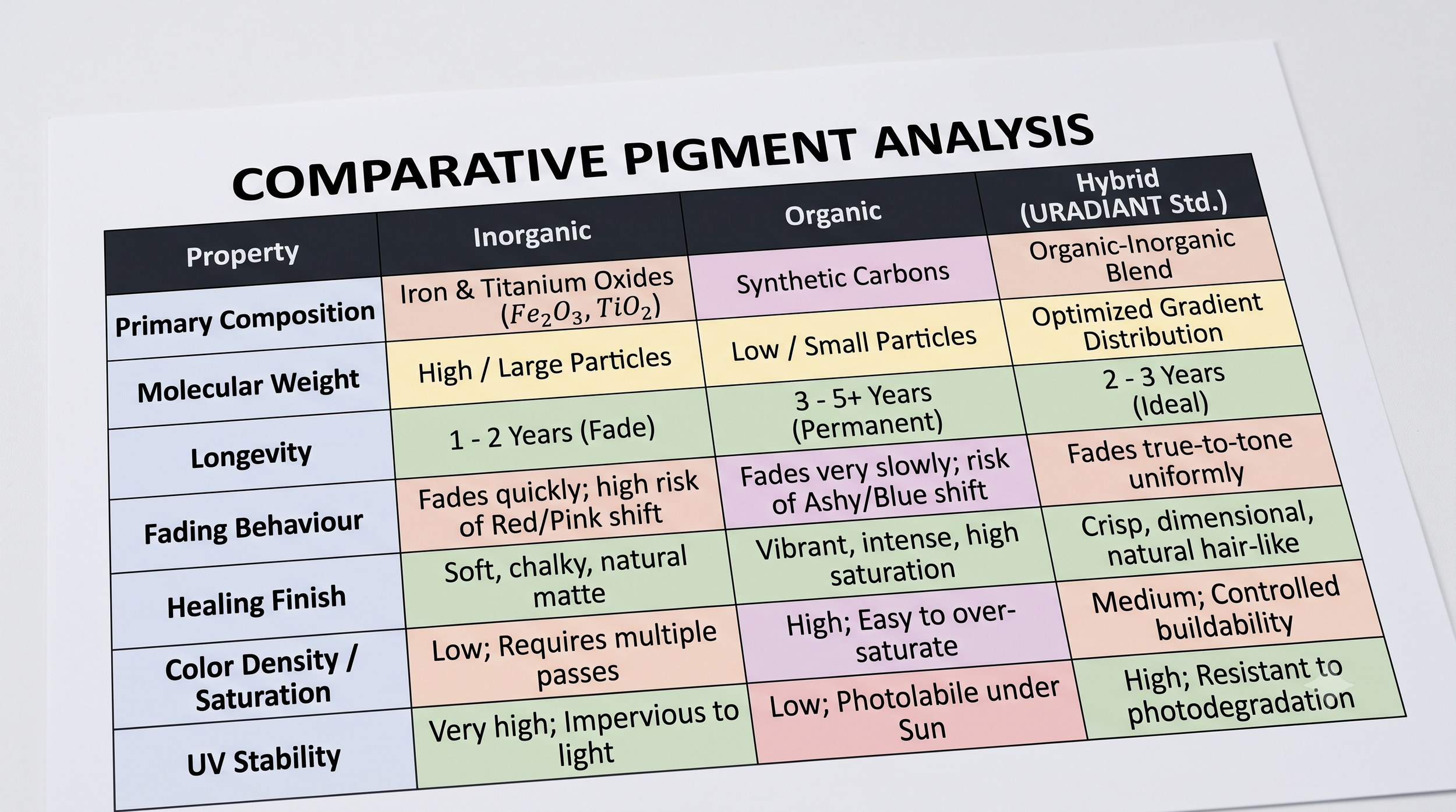
The URADIANT Practice: The Hybrid Pigment Advantage
At URADIANT, our commitment to clinical excellence means we never compromise on raw materials. Despite Hybrid pigments carrying a significantly higher manufacturing cost, we exclusively use FDA-compliant, European-certified Hybrid Pigments for all Nano Brow procedures.
Why Hybrid Pigments represent the Best of Both Worlds:
Engineered Stability: Hybrid formulations combine the soft, natural earthy tones of Inorganic Iron Oxides with the color-fast stability of Organic carbon molecules.
Uniform Degradation: The particle sizes are calibrated so that the warm and cool tones degrade at the exact same metabolic rate.
Zero Colour Shift: Combined with our single-needle Nano Brow machine control—which avoids deep tissue trauma and bleeding—our clients experience zero colour shift to red, salmon, or green.
As the pigment ages gracefully over 2 to 3 years, it simply lightens in saturation, remaining true to its original tone. This leaves your dermal canvas clean, healthy, and ready for future color refreshes without the need for laser removal.
Scientific References
Baranska, A., et al. (2018).Unveiling skin macrophage dynamics explains tattoo persistence.Journal of Experimental Medicine, 215(4), 1115–1133.
Sepehri, S., & Serup, J. (2015).Tattoo Pigments: Chemistry, Toxicology and Photochemical Fate in the Skin.Current Problems in Dermatology, 48, 28–35.
Paul, F., et al. (2011).Biocompatibility and Safety Profile of Synthetic Iron Oxide Nanoparticles in Dermatological Applications.International Journal of Molecular Sciences, 12(10), 6580–6597.
Hauri, U. (2011).Photostability and Oxidative Degradation of Cosmetic Tattoo Pigments Under Exposure to Solar Light.Journal of the European Academy of Dermatology and Venereology, 25(8), 920–928.
Dirks, M. (2017).Modern Pigment Formulations and Chemical Regulations (REACH) in Permanent Beauty Applications.Archives of Dermatological Research, 309(6), 481–489.
[ Explore our rituals : Nano Brows, Lip Blush & Dark Lip Neutralisation, SMP]
URADIANT SYDNEY | Visit our sanctuary, The Alchemy of Light, Art and Transformation
110D Boundary Street, Paddington NSW 2021. [Link: Get Directions]