The Science of Iron Oxide in Brow Tattooing: Debunking Toxicity Myths, MRI Safety, and Modern Pigment Chemistry
When clients hear the phrase "iron oxide" or "metal oxides" in cosmetic pigments, a wave of hesitation often follows. Is it safe to implant metal-derived minerals into the skin? Will it turn red? Will it cause burns during a hospital MRI scan?
As a former Medical Radiation Therapist, I have spent years working directly with medical imaging, radiation physics, and cellular biology. In aesthetic micropigmentation, iron oxide is not an industrial hazard—it is one of the most biocompatible, thoroughly researched, and stable mineral groups in dermatology.
Here is the clinical truth about iron oxide pigments: where they come from, how they behave beneath the dermis, why they are completely MRI-safe, and how URADIANT uses high-grade Hybrid chemistry to deliver natural, true-to-tone retention.
1. Debunking the Toxicity Myth: Iron Oxide in Nature and Biology
The assumption that iron oxide is an "unnatural toxin" ignores both geology and basic human physiology:
The Australian Earth: Iron oxide is the very element responsible for the iconic rich red and ochre colours of the Australian Outback. Mineral forms such as Hematite (Fe2O3) and Goethite have existed in the natural earth for millennia.
Our Own Biology: Iron is a fundamental building block of human life. The iron ion (Fe2+/Fe3+) sits at the active centre of haemoglobin in our red blood cells, binding oxygen and giving human blood its red hue.
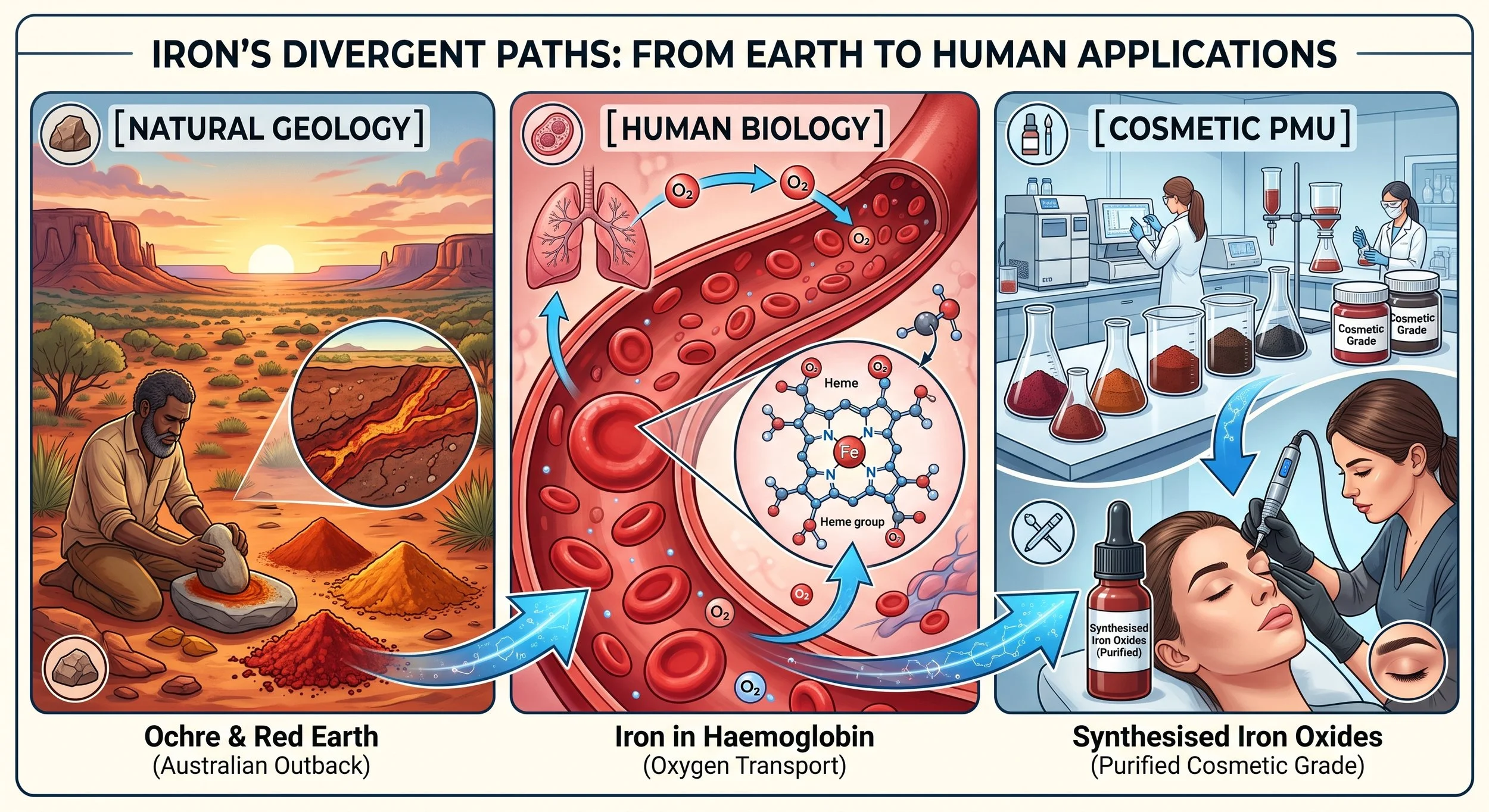
Cosmetic Purity vs. Raw Ore
Cosmetic tattoo pigments do not use unrefined dirt from the ground. They use synthetically manufactured, cosmetic-grade iron oxides produced under sterile laboratory conditions:
Black Iron Oxide (Fe3O4 / Ferrous-Ferric Oxide): Provides cool, deep foundational tones.
Red Iron Oxide (Fe2O3 / Ferric Oxide): Provides natural warmth and earthy undertones.
Yellow Iron Oxide (FeO(OH) / Hydrated Ferric Oxide): Delivers golden, neutralising highlights.
These minerals undergo strict purification to remove all heavy metal impurities (such as lead, arsenic, and mercury), making them completely non-toxic, hypoallergenic, and inert within the skin.
2. Which Pigments Contain Iron Oxide?
Cosmetic pigments are classified into three primary categories based on their chemical composition:
Pure Inorganic Pigments: Composed entirely of mineral oxides—primarily Iron Oxides, Titanium Dioxide (TiO2), and Chromium Green. They yield a soft, velvety, natural matte finish.
Pure Organic Pigments: Made of synthetic carbon-ring structures (Azo dyes, Quinacridones). They contain no iron oxides and deliver vibrant, long-lasting tinting strength.
Hybrid Pigments (The URADIANT Standard): An engineered fusion combining the soft, earthy biocompatibility of inorganic iron oxides with the light-fast stability of synthetic organic carbon molecules.
3. How Iron Oxide Degrades Beneath the Dermis
When a single needle implants iron oxide into the upper dermis (papillary dermis), the body's immune response is exceptionally mild because iron is a familiar biological element.
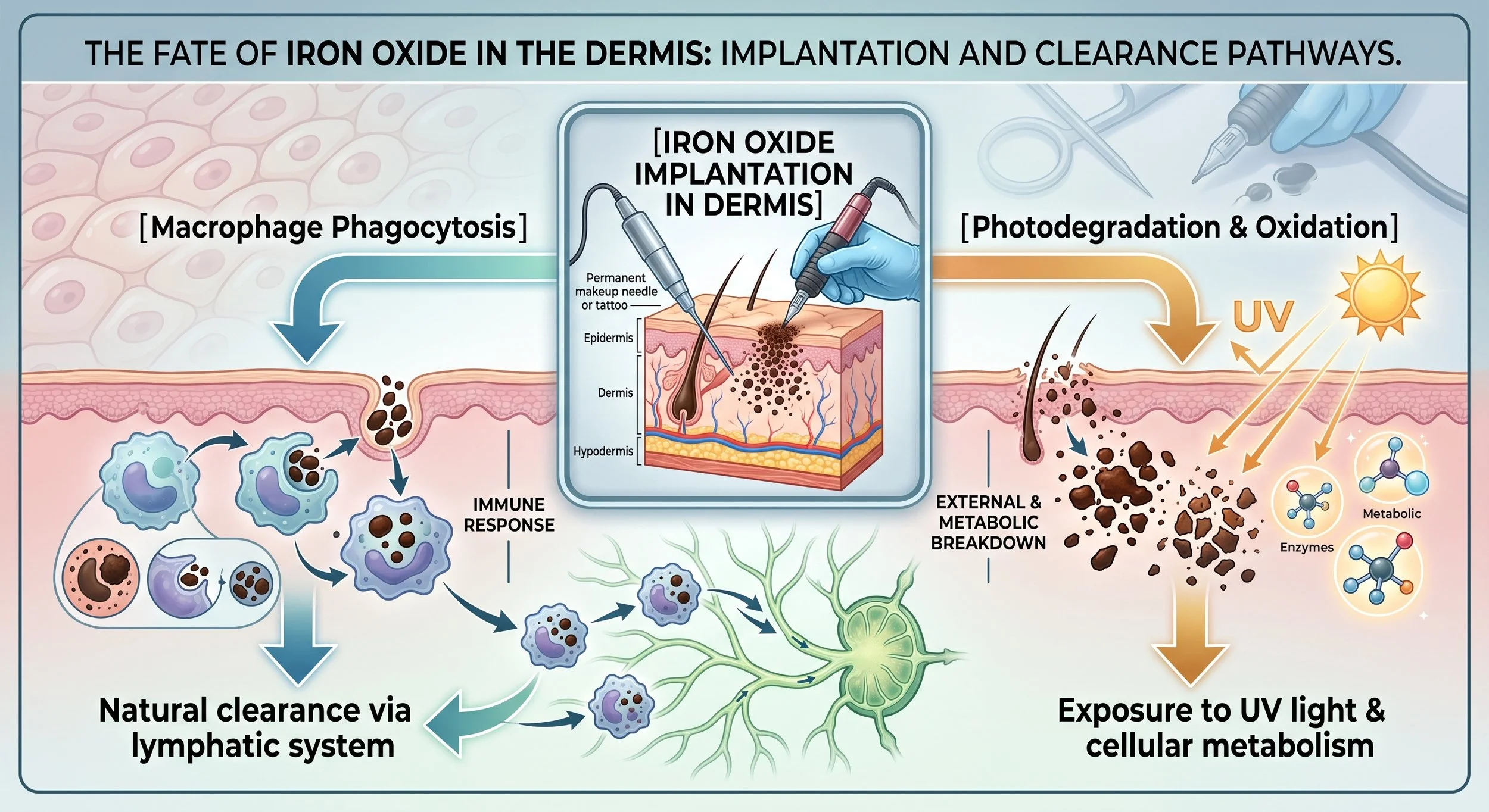
Why Did Old Iron Oxide Tattoos Turn Red?
In traditional PMU formulations, a common issue was the differential degradation rate of the colour blend:
Black iron oxide and yellow iron oxide have smaller particle sizes and lower oxidative resistance under UV light compared to red iron oxide.
In older formulations, the black and yellow particles broke down and were cleared by macrophages first, leaving behind the larger, highly stable Red Iron Oxide (Fe2O3) molecules. This caused the brow to fade into an unwanted salmon-pink or orange shade.
4. The MRI Question: Can You Have a Magnetic Resonance Scan with PMU?
A persistent urban legend claims that having a cosmetic tattoo with iron oxide will cause your skin to "burn," "rip," or overheat during an MRI (Magnetic Resonance Imaging) scan.
As someone with professional training in radiation therapy and medical imaging environments, I can confirm that this concern is overwhelmingly unfounded.
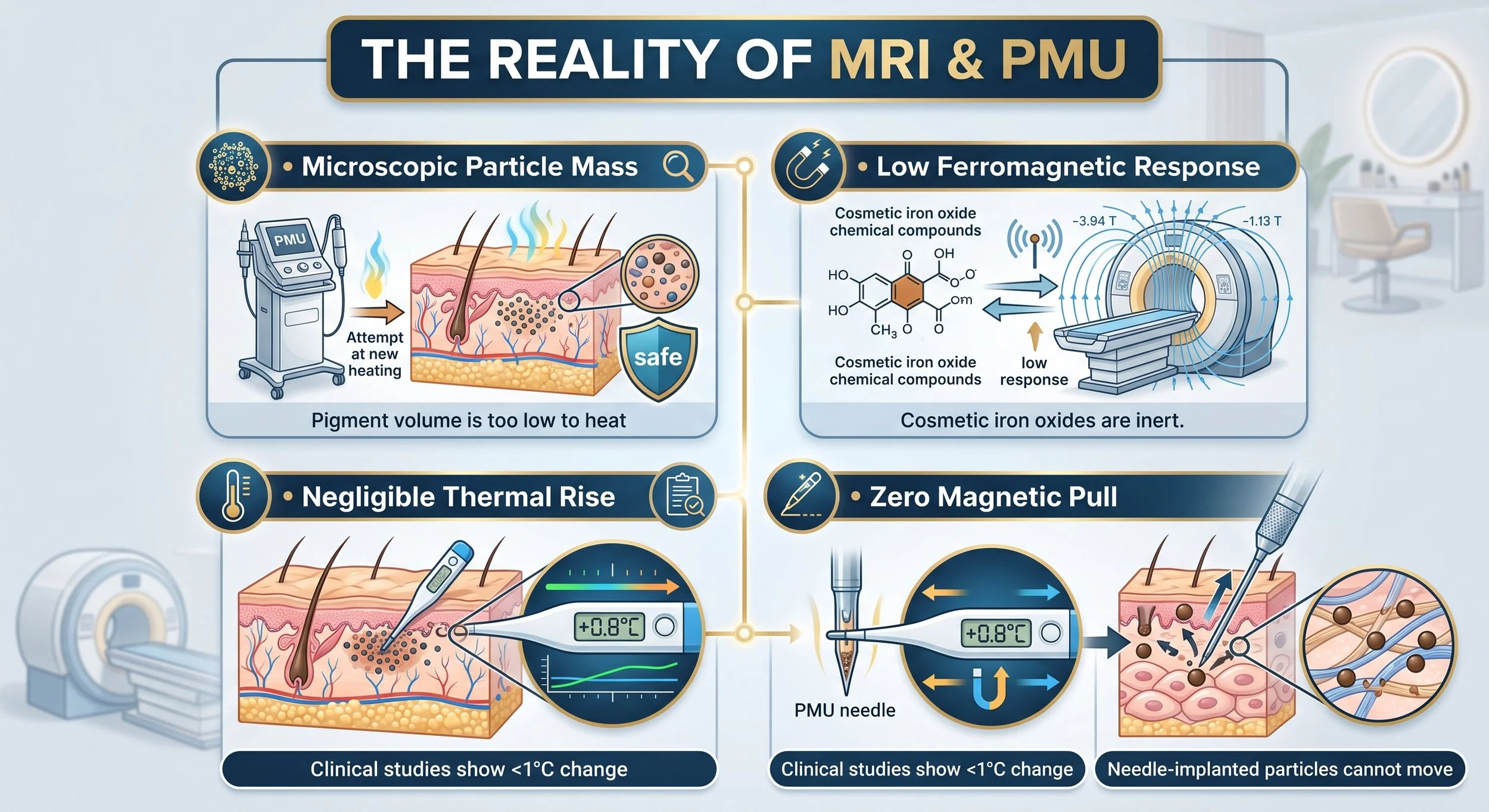
Microscopic Particle Mass: An MRI machine generates powerful static magnetic fields and radiofrequency (RF) pulses. However, the total volume of iron oxide implanted in a Nano Brow procedure is measured in fractions of a milligram—far too small to create magnetic torque (pulling) or conduct significant electrical currents.
Thermal Safety: Extensive clinical studies published in radiology journals confirm that cosmetic tattoo pigments cause negligible temperature elevations (typically less than 1∘C), which is completely safe for human tissue.
Diagnostic Artifacts: The only minor consideration is that iron oxide can produce a tiny, localised visual shadow (artifact) on an MRI image if the scan is focused directly on the eye socket or orbit. Simply inform your radiographer that you have permanent makeup before your scan.
5. The URADIANT Solution: Advanced Hybrid Pigment Engineering
At URADIANT, we use European FDA/REACH-certified Hybrid Pigments to ensure our clients enjoy the safety of iron oxides without the old-fashioned risk of colour shifts.
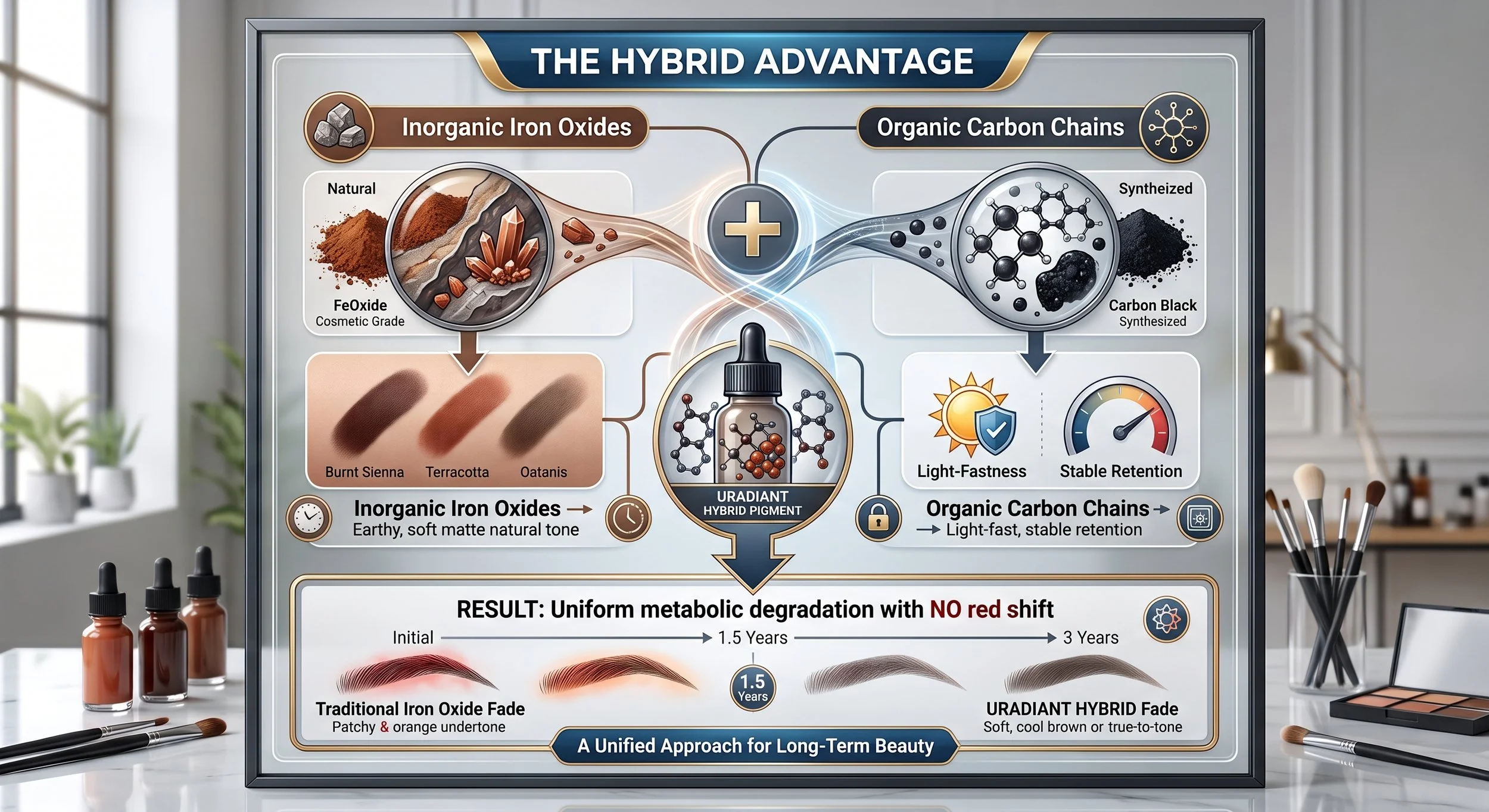
By balancing pure iron oxides with calibrated organic carbon chains:
True-to-Tone Degradation: The particle sizes are calibrated to break down at the exact same rate. As your brows age over 2 to 3 years, they simply soften in saturation rather than turning salmon pink or grey.
Single-Needle Precision: Implantation via micro-channels into the upper dermis prevents deep ink pooling, ensuring complete biocompatibility and flawless retention.
Scientific & Clinical References
Paul, F., et al. (2011).Biocompatibility and Safety Profile of Synthetic Iron Oxide Nanoparticles in Dermatological Applications.International Journal of Molecular Sciences, 12(10), 6580–6597. (Demonstrates the biological tolerance, cellular clearance, and non-toxic profile of purified synthetic Fe2O3).
Klumpp, B., et al. (2013).Cutaneous reactions and safety of permanent makeup in magnetic resonance imaging.Radiology, 266(3), 852–859. (Clinical assessment proving the thermal safety and negligible RF heating of cosmetic tattoo pigments during high-field MRI scans).
Baranska, A., et al. (2018).Unveiling skin macrophage dynamics explains tattoo persistence.Journal of Experimental Medicine, 215(4), 1115–1133. (Details how dermal macrophages process and encapsulate mineral particles within the collagen matrix).
Hauri, U. (2011).Photostability and Oxidative Degradation of Cosmetic Tattoo Pigments Under Exposure to Solar Light.Journal of the European Academy of Dermatology and Venereology, 25(8), 920–928. (Explains differential photo-oxidation rates between red, yellow, and black iron oxides).
Dirks, M. (2017).Modern Pigment Formulations and Chemical Regulations (REACH) in Permanent Beauty Applications.Archives of Dermatological Research, 309(6), 481–489. (Outlines the purity standards and stability testing of modern hybrid formulations).
[ Explore our rituals : Nano Brows, Lip Blush & Dark Lip Neutralisation, SMP]
URADIANT SYDNEY | Visit our sanctuary, The Alchemy of Light, Art and Transformation
110D Boundary Street, Paddington NSW 2021. [Link: Get Directions]