The Chemistry of the "Green Brow": Why Old Tattoos Changed Colour and How Modern Precision Prevents It
Many individuals who recall cosmetic tattooing from ten or fifteen years ago share a common hesitation: the fear that their brows will eventually turn a shade of dull charcoal, teal, or harsh forest green.
Historically, this concern was entirely valid. Older cosmetic tattoos frequently shifted to unnatural cool tones as they aged. However, in modern aesthetic micropigmentation, the occurrence of green or blue colour shifts has drastically declined.
As a practitioner with a background in Medical Radiation Therapy, I view pigment retention as a balance of chemistry, optics, and precise dermal mechanics. Here is the science of why old cosmetic tattoos turned green, how advanced practitioner training has transformed the industry, and why URADIANT’s single-needle Nano Brow technique ensures zero colour shift.
Why Did Older Cosmetic Tattoos Turn Green?
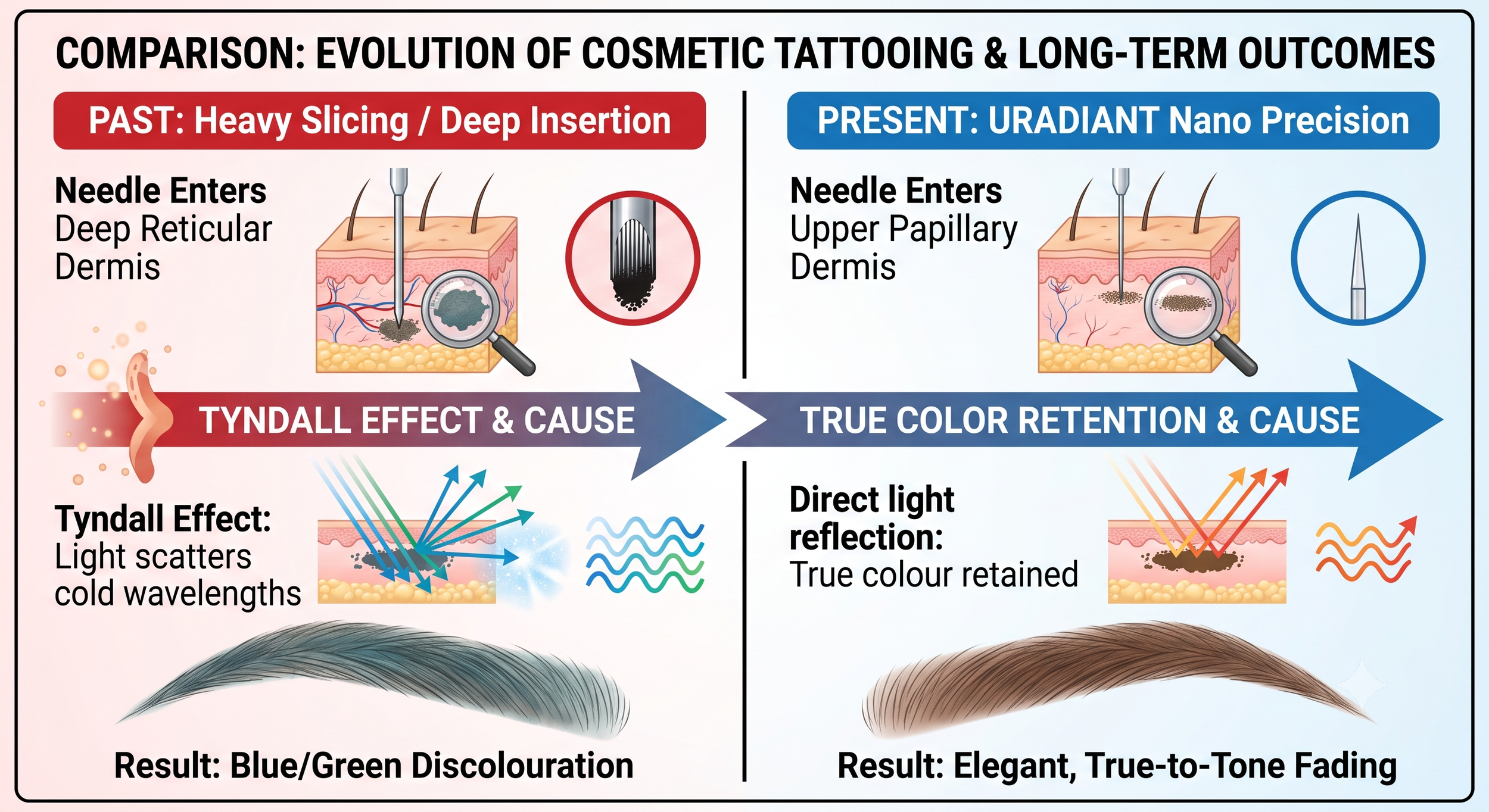
1. Pigment Composition of the Past
In the early days of cosmetic tattooing, artists frequently utilised traditional body tattoo inks or unrefined industrial pigments.
Impure Black Formulations: To create "black" or "dark brown" ink, manufacturers often blended heavy synthetic pigments, including Phthalocyanine Green and Phthalocyanine Blue.
Differential Degradation: Warm pigment components (such as red and yellow iron oxides) are smaller and metabolised faster by dermal macrophages under UV exposure. Once the warm molecules degraded, the large, highly stable Phthalocyanine Green particles remained trapped in the tissue, exposing a stubborn green-blue hue.
2. Excessive Depth and the Tyndall Effect
When pigment is placed too deep into the skin—penetrating through the upper dermis down into the reticular dermis or subcutaneous fat—it interacts with light differently due to the Tyndall Effect.
As ambient light passes through thick layers of overlying tissue, longer warm wavelengths (red and yellow) are absorbed by the skin.
Shorter, cooler wavelengths (blue and green) are scattered back to the eye. Consequently, even an earthy brown pigment will appear cold, slate-grey, or teal when buried too deeply.
The Modern Evolution: Why Green Brows Are Becoming Extinction
Today, instances of green or blue pigment shifts have plummeted across the professional PMU industry. This positive shift is driven by three major advancements in practitioner training and technology:
Science-Led Pigment Selection: Modern artists are trained in advanced pigment chemistry. We now utilise stable Hybrid Pigments formulated with warm modifiers to ensure that as the pigment degrades over time, it lightens uniformly without separating into raw primary colours.
Controlled Hand Pressure: Advanced dermal education teaches artists to respect skin variations. Knowing the exact structural thickness of the orbital skin prevents heavy-handed application.
Low-Speed Digital Devices: Modern digital machines feature adjustable, low-speed controls. Low speed allows the needle to deposit pigment gently without tearing tissue or burying ink into deep dermal layers.
The URADIANT Protocol: 100% Nano Precision, Zero Colour Shift
At URADIANT, we do not perform traditional manual microblading. We work exclusively with Machine Nano Brows—the gold standard in skin conservation.
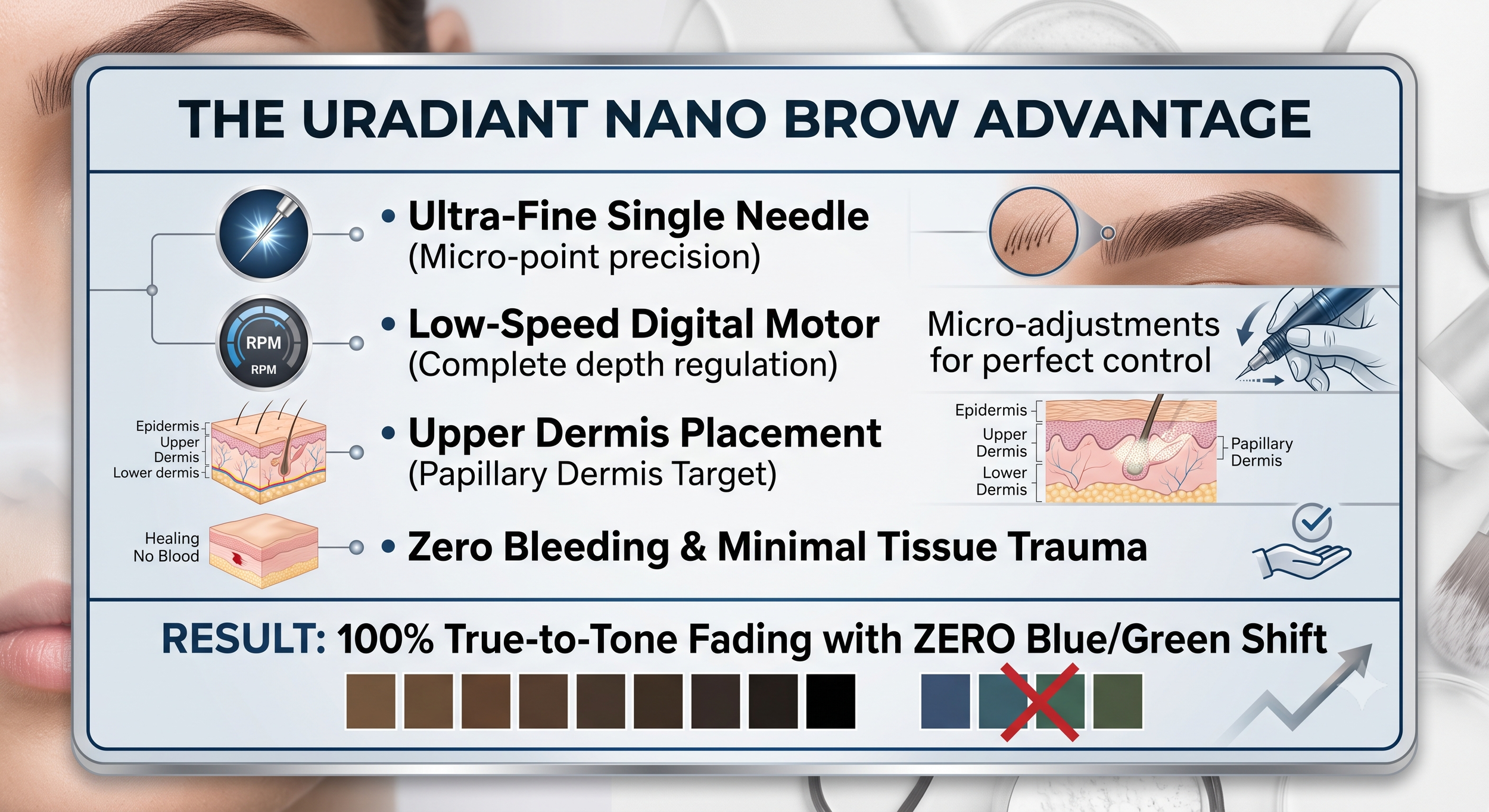
By utilising an ultra-fine single needle driven by an acoustic digital motor operating at controlled low speeds, we achieve absolute, microscopic depth control. Pigment is deposited precisely into the upper dermis (papillary dermis)—far above the depth threshold where the Tyndall Effect occurs.
Because of this single-needle precision and our high-purity European-certified pigments, not a single URADIANT client experiences a shift to blue or green.
The True Value of Semi-Permanent Fading: Flexibility for Life
Rather than turning green, your Nano Brows will simply soften in saturation over 1 to 3 years, fading gracefully true-to-tone.
This gradual, uniform lightening is actually the greatest benefit of modern semi-permanent makeup:
Adaptability to Aging: As your facial features, hair colour, and natural skin elasticity change over time, soft fading allows us to adjust your brow shape and tone during your annual touch-up.
Freedom from Permanent Commitment: Unlike permanent body tattoos that leave behind locked, altered pigments, true semi-permanent Nano Brows maintain a clean dermal canvas.
No Scarring: Because our low-speed single needle causes zero slicing trauma, the skin matrix remains smooth, allowing you to refresh or refine your brows for decades without building up fibrotic scar tissue.
Scientific ReferencesSepehri, S., & Serup, J. (2015). Tattoo Pigments: Chemistry, Toxicology and Photochemical Fate in the Skin.Current Problems in Dermatology, 48, 28–35. (Examines chemical breakdown and light stability of Phthalocyanine green vs iron oxides).
Dirks, M. (2017). Modern Pigment Formulations and Chemical Regulations (REACH) in Permanent Beauty Applications. Archives of Dermatological Research, 309(6), 481–489. (Details modern hybrid pigment stability and uniform fading dynamics).
Zhen, X., et al. (2020). The effects of needle insertion parameters on skin injury and wound closure. Journal of the Mechanical Behavior of Biomedical Materials, 103, 103588. (Demonstrates depth control and tissue preservation using low-speed micro-punctures).
[ Explore our rituals : Nano Brows, Lip Blush & Dark Lip Neutralisation, SMP]
URADIANT SYDNEY | Visit our sanctuary, The Alchemy of Light, Art and Transformation
110D Boundary Street, Paddington NSW 2021. [Link: Get Directions]