The Overlooked Variable: Why Inadequate Pigment Shaking Causes Brow Colour Shifts
When a cosmetic eyebrow tattoo unexpectedly heals or fades into an unwanted tone—such as an unnatural salmon-pink or dull ash—the blame is usually placed on skin undertones, sun exposure, or needle depth.
However, one of the most common catalysts for pigment shift occurs before the needle ever touches the skin: failing to thoroughly homogenise the pigment suspension.
In the daily rush of a busy clinic, shaking a pigment bottle for only a few seconds is an easy oversight. Yet from a chemical and physical standpoint, this small oversight completely alters the formulation designed by the manufacturer.
As a former Medical Radiation Therapist, I look at pigment bottles through the laws of fluid dynamics, specific gravity, and particle physics. Here is the science of sedimentation, why an unmixed bottle distorts colour ratios, and the clinical inspection protocol we use at URADIANT to guarantee chromatic stability.
1. The Physics of Sedimentation: Why Pigment Separates
Cosmetic tattoo pigment is not a homogenous liquid or chemical solution; it is a colloidal suspension. Solid micro-particles of various minerals are suspended in a liquid carrier system (typically consisting of purified water, glycerin, and alcohol).
Each mineral in a formulation possesses a distinct density, molecular weight, and particle size:
Titanium Dioxide (TiO2): Exceptionally dense, heavy particles that settle quickly to the base.
Inorganic Iron Oxides (Fe2O3,Fe3O4): Denser, larger mineral particles (1.0–2.0 microns) with high specific gravity.
Synthetic Organic / Carbon Black: Extremely light, microscopic particles (0.1–0.5 microns) that stay suspended in the carrier fluid longer.
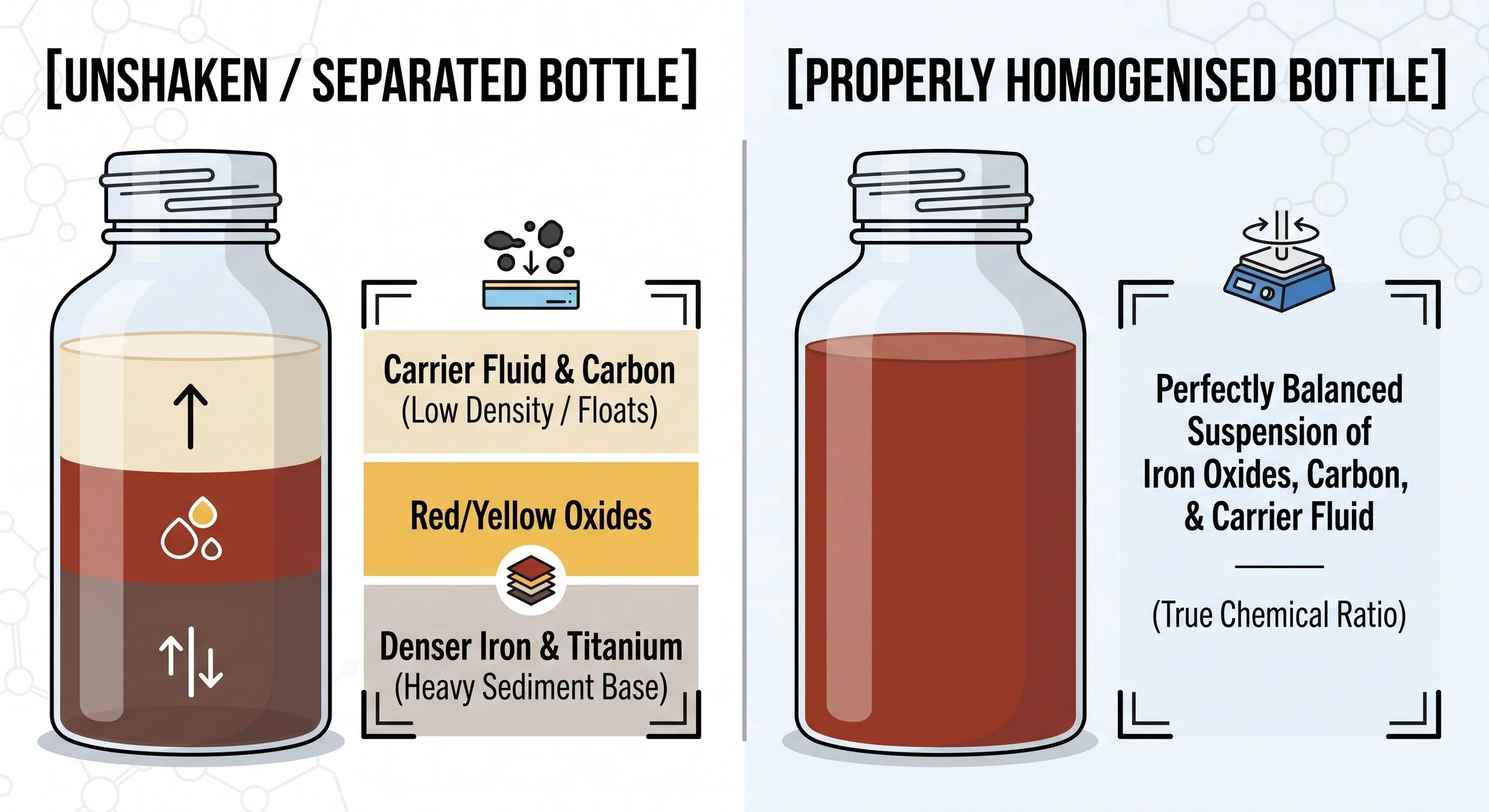
When a bottle sits upright between appointments, gravitational forces cause these particles to separate based on their mass—a process known in physics as sedimentation. The heaviest iron oxides and titanium settle into a thick, compacted sludge at the bottom, while the lighter carbon particles and carrier liquid remain at the top.
2. Distorting the Stoichiometry: What Goes onto the Skin
Manufacturers spend years testing the exact ratio of black, red, and yellow particles to ensure that as the pigment degrades under metabolic and UV exposure, it lightens uniformly without shifting tone.
When you dispense pigment from a bottle that has not been completely mixed, you fundamentally alter that chemical ratio:
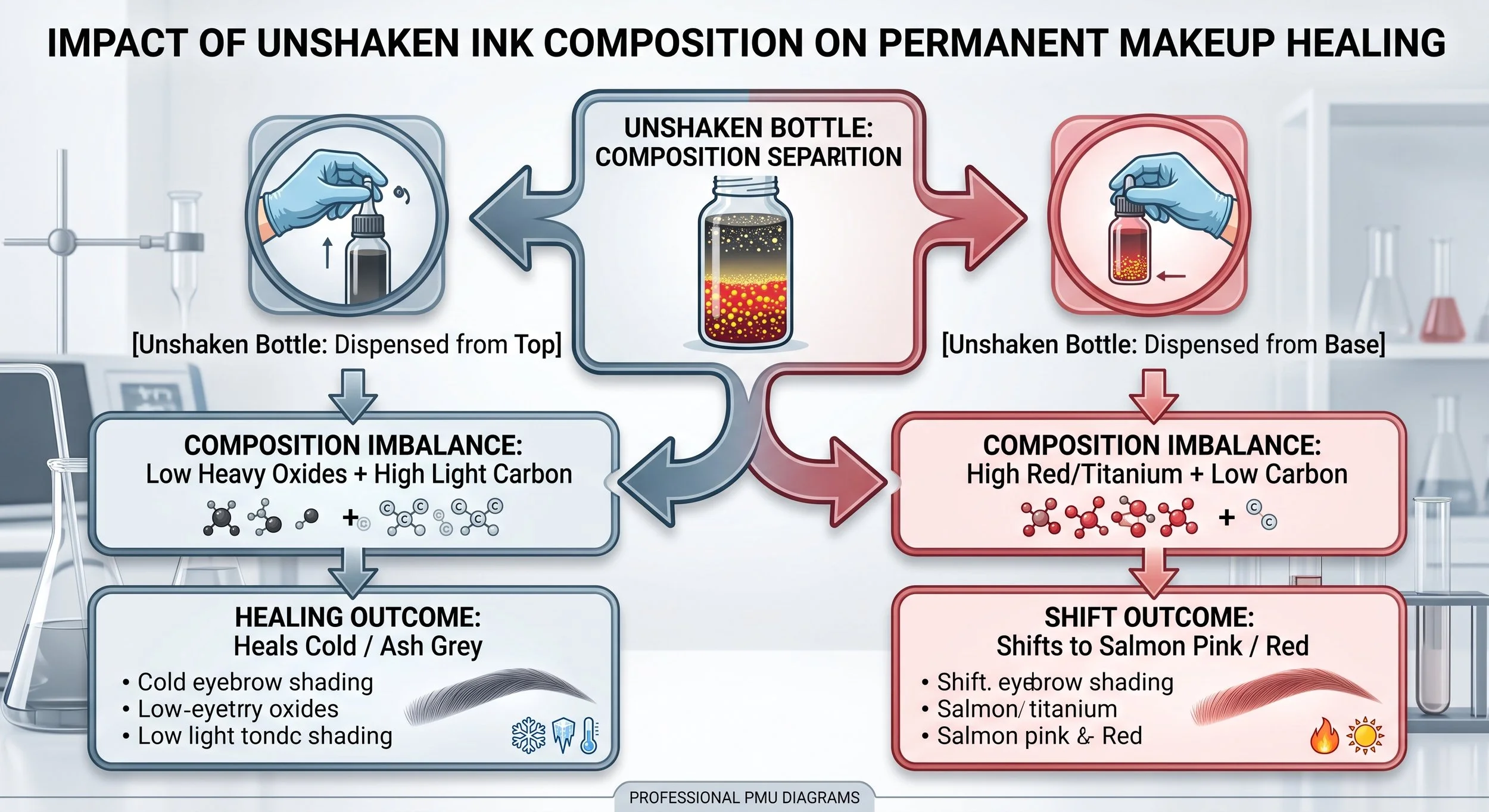
Dispensing from the Top Layer: If you draw from the upper portion of an unmixed bottle, you are largely dispensing carrier fluid and light carbon. The mixture will lack the dense warm iron oxides necessary to balance the cool tones, leading to an ashy, cool, or dull grey healed result.
Dispensing from the Dense Base: Conversely, once that top fluid is depleted, subsequent drops will contain an excessively high concentration of dense red iron oxide. Over time, as the minor carbon traces metabolise, the brow shifts to a persistent salmon-pink or orange because the ratio was overloaded with heavy red minerals from day one.
3. The URADIANT Protocol: Beyond the "One-Minute" Rule
Standard manufacturer instructions often advise shaking the bottle for 30 to 60 seconds. In clinical practice, this rule of thumb is frequently insufficient—particularly for high-viscosity hybrid formulations that have sat undisturbed on a shelf.
At URADIANT, our standard operating procedure goes beyond timed shaking to include active visual verification:
Multi-Axis Agitation: We agitate the bottle vigorously across multiple axes (vertical, horizontal, and rotational) to break up compacted sediment from both the base and the sidewalls.
Clinical Light Inspection: Before dispensing, hold the transparent or translucent bottle directly beneath bright, high-CRI task lighting. Inspect the base and corners for any remaining sediment rings or streaking along the internal plastic walls.
Dispense Only When Uniform: The pigment should dispense with a smooth, uniform viscosity and consistent colour depth across every single drop.
By ensuring the pigment is 100% homogenised, you ensure that what enters the client's dermis is the exact, scientifically calibrated formulation intended to fade true to tone over 2 to 3 years.
Scientific & Physical References
Sepehri, S., & Serup, J. (2015). Tattoo Pigments: Chemistry, Toxicology and Photochemical Fate in the Skin.Current Problems in Dermatology, 48, 28–35. (Discusses suspension mechanics, particle size distribution, and specific gravity of cosmetic oxides).
Dirks, M. (2017). Modern Pigment Formulations and Chemical Regulations (REACH) in Permanent Beauty Applications. Archives of Dermatological Research, 309(6), 481–489. (Details stoichiometric balancing in hybrid pigments and uniform degradation criteria).
Hunter, R. J. (2001). Foundations of Colloid Science (2nd ed.). Oxford University Press. (Theoretical principles of gravitational sedimentation, particle aggregation, and suspension rheology).
[ Explore our rituals : Nano Brows, Lip Blush & Dark Lip Neutralisation, SMP]
URADIANT SYDNEY | Visit our sanctuary, The Alchemy of Light, Art and Transformation
110D Boundary Street, Paddington NSW 2021. [Link: Get Directions]