The "Botched Brow" Crisis: Brow Shock, Facial Psychology, and the Critical 48-Hour Decision Window
Few aesthetic moments feel as overwhelming as standing in front of your bathroom mirror 24 hours after a cosmetic brow tattoo, staring at your reflection in utter panic.
At URADIANT, my inbox frequently receives urgent messages from individuals who had their brows done elsewhere and are convinced their face has been ruined. They send late-night photos accompanied by frantic questions: "Are they too dark?" "Why do they look so thick?" "My partner says they look terrible—should I get them lasered off tomorrow?"
Before you enter a state of distress or seek out aggressive laser removal, pause.
In clinical practice, a significant portion of so-called "botched brows" are not botched at all—they are the result of a predictable psychological phenomenon known as Brow Shock, combined with the natural biological darkening of healing pigment. However, if a structural mistake has genuinely occurred, timing is critical.
Here is an expert breakdown of the psychology behind post-procedure panic, how to conduct an objective self-assessment, and the strict biological timeline for emergency correction.
1. The Neurobiology of "Brow Shock" and Loved Ones' Reactions
To evaluate your fresh brows objectively, you must first understand the cognitive dissonance currently occurring in your brain—and in the minds of the people living with you.
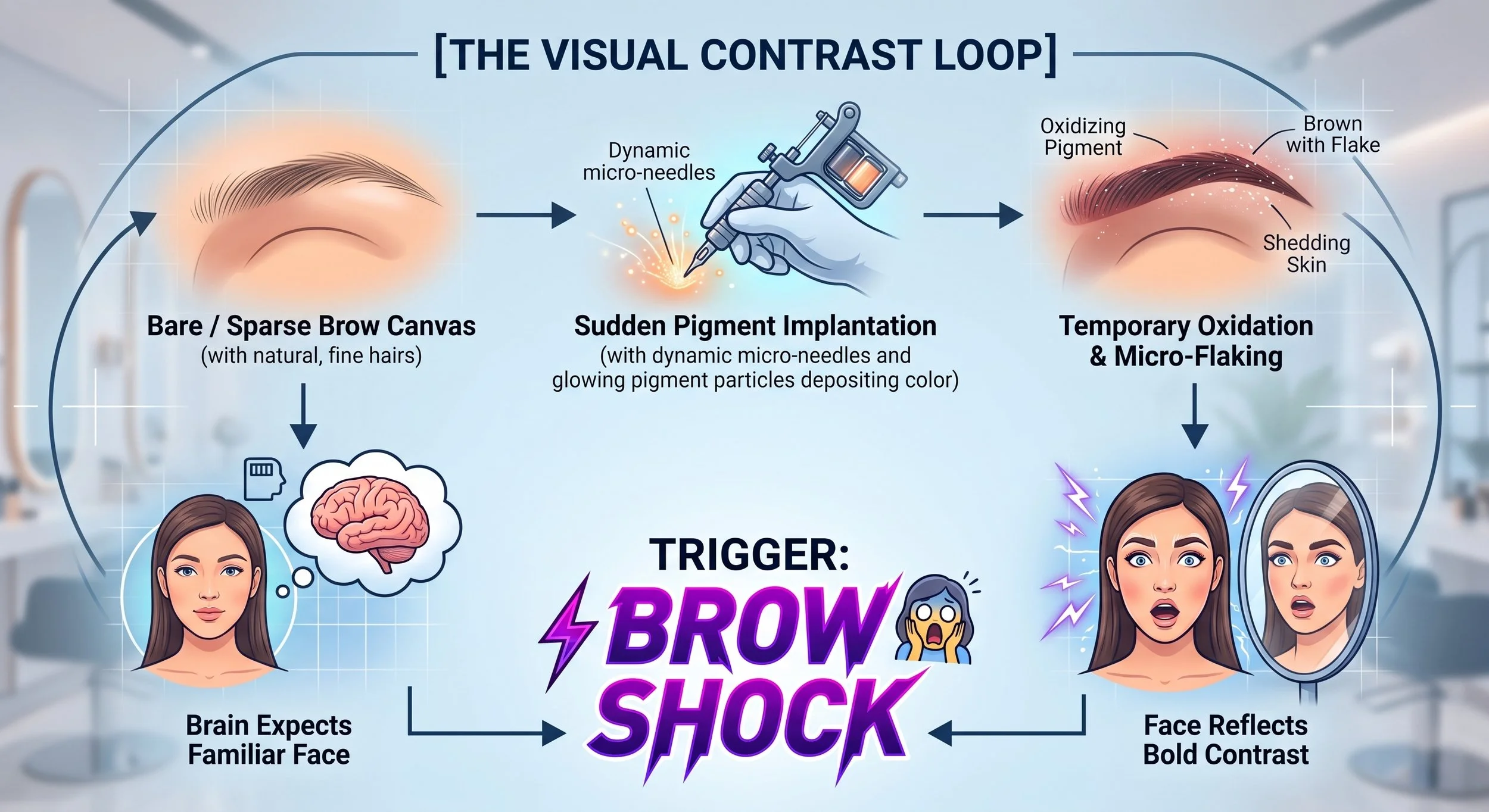
Why You Experience Brow Shock
If you are someone who rarely wears makeup, or if you have lived with sparse, faint eyebrows for years, your brain has established an ingrained neural map of your facial geometry.
Immediately after a procedure, pigment oxidises upon contact with air and mixes with microscopic traces of surface lymph, forming a thin, protective micro-crust.
This temporarily darkens and broadens the look of the brows during days 1 to 5.
Because the contrast is sudden and intense, your brain interprets this unfamiliar image as a threat to your identity, triggering an immediate impulse to "wipe it off."
The Psychology of Partners and Friends
A major catalyst for client panic is the reaction of close friends or partners. You walk into the kitchen hoping for reassurance, only to be met with: "What happened to your face? They're huge!"
Do not let their initial reaction dictate your emotional state. Human beings process familiar faces holistically through the Fusiform Face Area (FFA) of the brain. When a loved one looks at you, their brain seeks instant confirmation of the face it knows intimately. When confronted with fresh, dark, unhealed pigment, their cognitive system reacts to the abrupt variance, not the technical quality of the hairstrokes. They cannot visualize the 30% to 40% softening that will occur once the micro-crust sheds; they are simply reacting to change.
2. The 3-Step Objective Self-Assessment Protocol
Before booking removal or letting panic take over, conduct this clinical self-assessment:
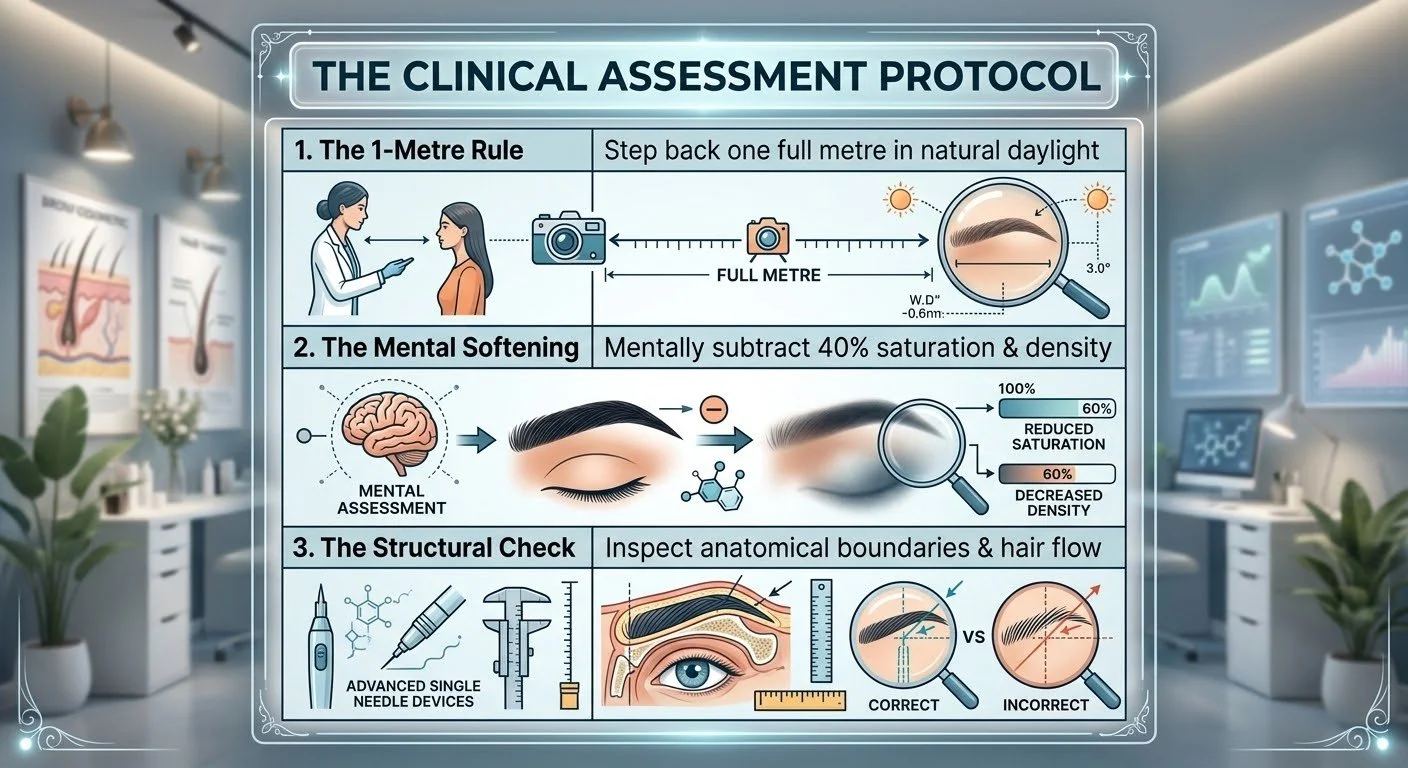
Step 1: The One-Metre Rule in Natural Light
Step away from high-magnification bathroom mirrors and harsh overhead LED lights. Stand one full metre away from a mirror positioned in soft, indirect natural daylight.
Nobody interacts with you through a 10x magnifying mirror. Stepping back allows you to assess the brows in relation to your entire facial architecture—your cheekbones, temporal width, and eye spacing—rather than obsessing over individual micro-dots.
Step 2: Mentally Calibrate for a 30% to 40% Reduction
Look at the current shape and envision the colour intensity dropping by almost half. Ask yourself: "If this exact shape were 40% softer, lighter, and feathery, would I be comfortable wearing it?" If the answer is yes, you are simply navigating the normal inflammatory oxidation phase.
Step 3: Check for Genuine Structural Errors
True technical failure is not about temporary dark colour; it is about anatomical misplacement. Check for these two red flags:
Strokes Outside Anatomical Boundaries: Has the pigment been tattooed excessively high above the superior orbital ridge or dropped far below the brow bone onto the mobile eyelid tissue?
Clashing Hair Flow: Do the tattooed strokes run completely perpendicular or contrary to the biological direction of your natural brow follicles, creating an obvious, unnatural cross-hatch?
If the strokes follow your natural bone contours and hair flow, the work is structurally sound—it simply needs time to heal.
3. The Biological Action Timeline: 48 Hours vs. 8 Weeks
If your self-assessment reveals genuine structural misplacement, your window to take immediate action is strictly limited by biological wound-healing mechanics.
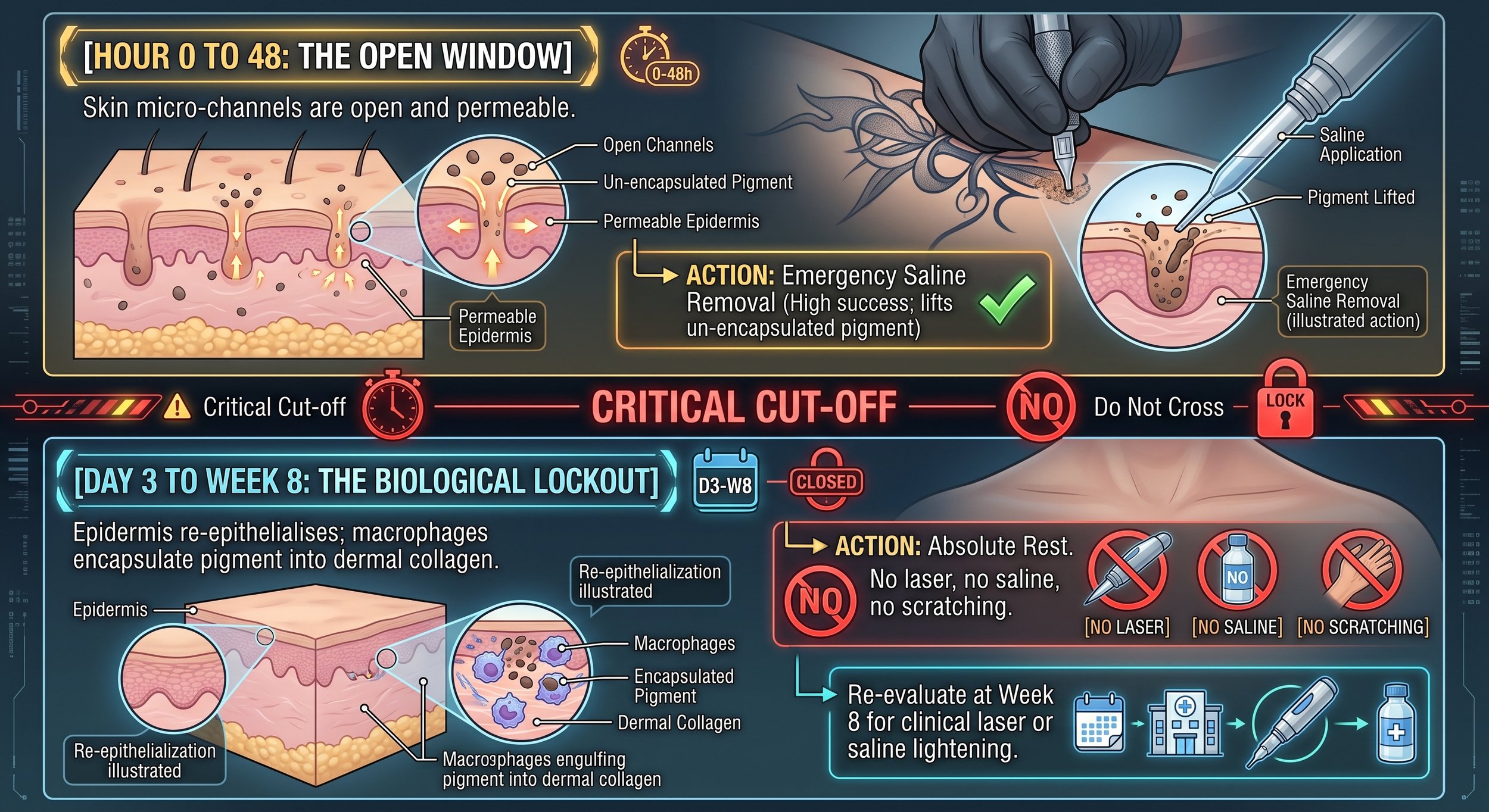
The 48-Hour Emergency Window: Saline Extraction
During the first 24 to 48 hours post-procedure, the epidermal micro-channels created by the needle remain unsealed by mature keratinocytes. The pigment particles sit loosely in the upper dermis and have not yet been fully locked into the extracellular collagen matrix.
Emergency Saline Removal utilizes an hypertonic saline solution applied to the open skin.
Through the scientific principle of osmosis, the high salt concentration draws interstitial fluid and suspended pigment particles upward toward the skin surface, extracting them before the barrier heals shut.
This procedure must be performed by a qualified removal specialist within 48 hours of the initial trauma.
The Biological Lockout: Why You Must Wait 6 to 8 Weeks
If that 48-hour window has passed, you must stop and leave the skin alone.
Attempting aggressive interventions—such as scrubbing the skin with chemicals, applying acid peels at home, or seeking immediate laser removal—on freshly tattooed, inflamed tissue is catastrophic. It will cause severe dermal ulceration, infection, and permanent hypertrophic scarring.
Once the skin seals on day three, the tissue enters the proliferative and remodelling wound phases. You must wait a mandatory 6 to 8 weeks for the epidermis to fully keratinise and the dermal matrix to settle. Only then can the true healed result be diagnosed, and safe corrective treatments (such as Picosecond laser removal or targeted non-laser lightening) be clinically mapped.
Seeking a Second Opinion at URADIANT
Experiencing brow panic can feel isolating, but you do not have to guess in the dark.
At URADIANT, we regularly provide objective, clinical second opinions for individuals navigating traumatic or uncertain brow results from other studios. We do not judge, and we do not provide false reassurance:
If your brows are simply undergoing healthy oxidation and brow shock, we will walk you through the histology, explain the healing phases, and offer peace of mind.
If your brows have suffered a genuine structural error, we will provide an immediate, honest triage plan—advising whether you qualify for emergency 48-hour extraction or helping you prepare a safe corrective roadmap for week eight.
If you are staring in the mirror unsure of what you are seeing, do not let panic push you into dangerous home remedies or premature laser sessions. Take a steady, well-lit photo in natural daylight and contact our Paddington clinic for a professional evaluation.
Scientific References
Kanwisher, N., McDermott, J., & Chun, M. M. (1997). The fusiform face area: a module in human extrastriate cortex specialized for face perception. Journal of Neuroscience, 17(11), 4302–4311. (Explains the cognitive and neural mechanisms behind holistic facial recognition and sensitivity to abrupt facial shifts).
Baranska, A., et al. (2018). Unveiling skin macrophage dynamics explains tattoo persistence. Journal of Experimental Medicine, 215(4), 1115–1133. (Details the timeline of dermal macrophage capture, highlighting the biological transition from free particles to encapsulated pigment).
Zhen, X., et al. (2020). The effects of needle insertion parameters on skin injury and wound closure. Journal of the Mechanical Behavior of Biomedical Materials, 103, 103588. (Documents the epidermal barrier closure rates and micro-channel permeability following cosmetic puncturing).
[ Explore our rituals : Nano Brows, Lip Blush & Dark Lip Neutralisation, SMP]
URADIANT SYDNEY | Visit our sanctuary, The Alchemy of Light, Art and Transformation
110D Boundary Street, Paddington NSW 2021. [Link: Get Directions]