Beyond the Art: Why Infection Control and Aseptic Technique Define a Truly Professional Cosmetic Tattoo Specialist
In the world of micropigmentation, clients often choose a studio based on healed brow photos or aesthetic style. However, before an artist ever touches a needle to your skin, there is a fundamental responsibility that supersedes art: Infection Control, Public Health Compliance, and Aseptic Technique.
Cosmetic tattooing - whether Nano Brows, Lip Blush, or Scalp Micropigmentation—is a skin penetration procedure. The moment a needle breaches the epidermal barrier to enter the upper dermis, the skin's natural defense mechanism is temporarily compromised.
As a practitioner with a background in Medical Radiation Therapy, I view every procedure through a strict clinical lens. Not just anyone can set up a machine and tattoo safely; it requires formal training, local council licensing, and a deep understanding of microbiology to protect both client and artist from cross-contamination.
1. The Legal & Clinical Baseline: Skin Penetration Licensing
In Australia, operating a cosmetic tattoo studio requires more than just artistic talent; it demands strict compliance with local council regulations and state public health legislation (such as the NSW Public Health Regulation).
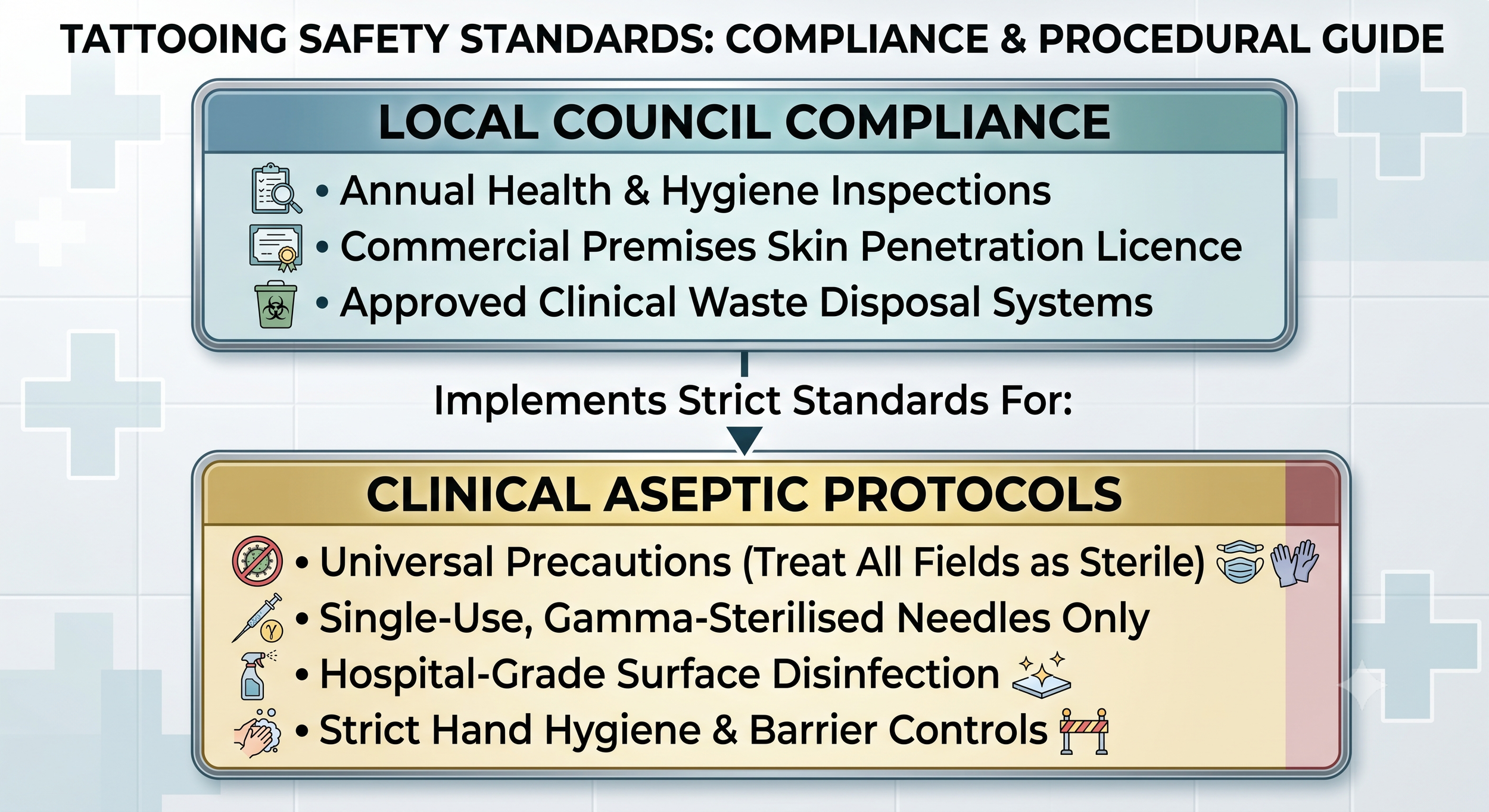
A licensed studio must be inspected to ensure it features non-porous, washable surfaces, appropriate hand-washing sinks separate from cleaning areas, and approved clinical sharps containers. These regulations exist to ensure that the environment where your procedure takes place meets the same foundational sanitation principles as a medical clinic.
2. Aseptic Technique vs. Basic Cleaning
There is a profound difference between a studio that is merely "clean" and an environment governed by Aseptic Technique.
Cleaning: Removing visible dirt and debris from a surface.
Disinfection: Using chemical agents to eliminate most recognised pathogenic microorganisms on inanimate objects.
Aseptic Technique: A clinical set of specific practices designed to prevent the transfer of microorganisms (bacteria, viruses, and fungi) from health professionals, healthcare environments, or equipment to a patient's open wound field.
In a PMU studio, true aseptic technique means establishing a sterile field. Every item that touches the client - from the single-needle cartridge to pigment caps, machine wrap, and wiping pads - must be single-use, sterile, or protected by disposable medical-grade barriers.
3. The Science of Cross-Contamination: What Happens When Hygiene Fails?
When infection control protocols are ignored or compromised, the biological risks are severe.
A. Bloodborne Pathogens (HIV, Hepatitis B & C)
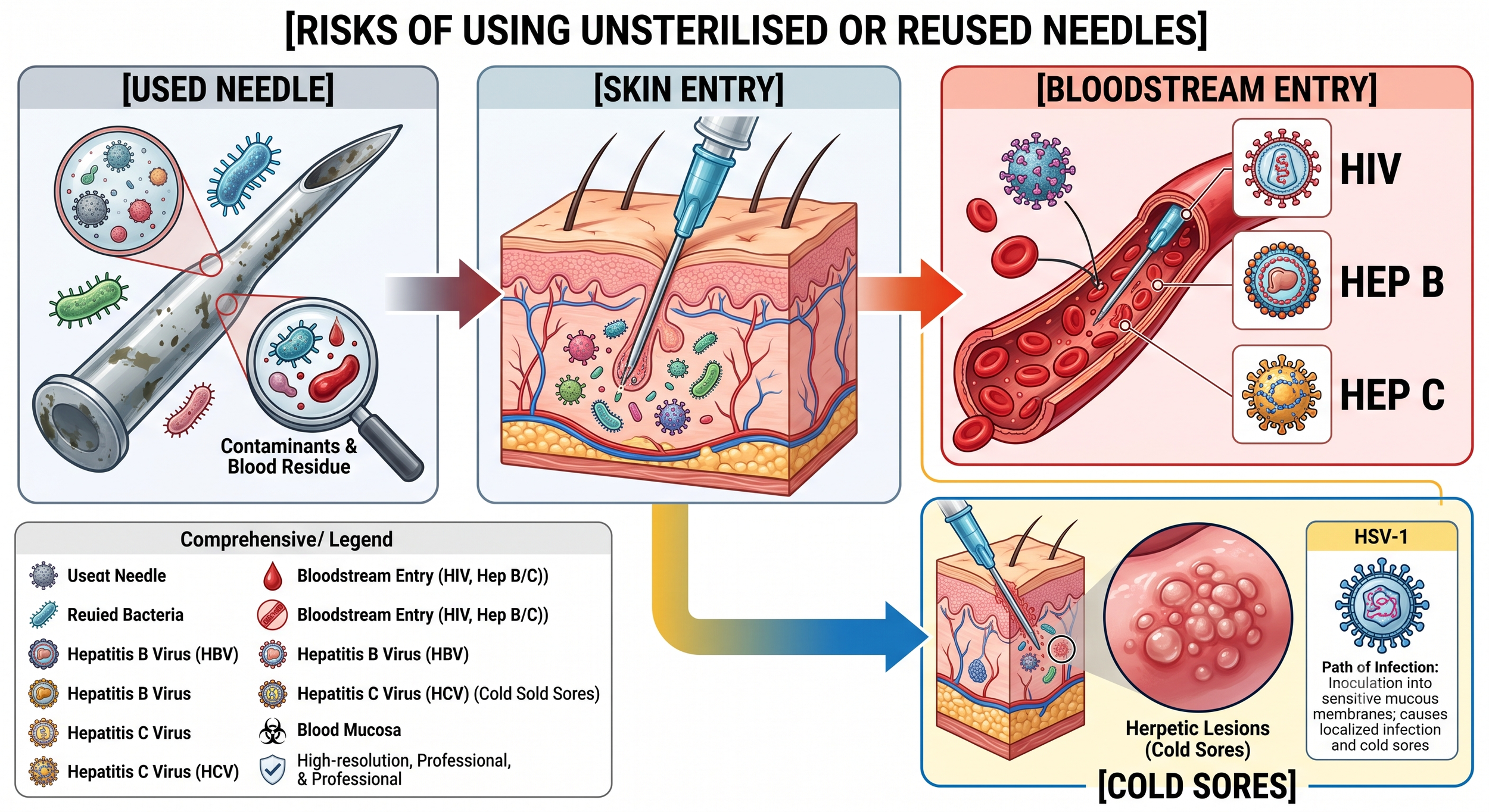
The reuse of disposable needles or failure to properly sterilise multi-use components carries a direct risk of transmitting Bloodborne Pathogens (BBVs).
The Mechanism: When a needle enters the dermis, microscopic amounts of blood and plasma are drawn back into the needle cartridge via capillary action or mechanical backstem suction.
The Reality: While extremely rare in licensed, professional environments, documented global cases exist - such as a public health investigation by the CDC revealing HIV transmission linked to unsterile cosmetic needle services at an unlicensed spa. The Human Immunodeficiency Virus (HIV) and Hepatitis C virus survive in microscopic blood traces; if a needle or pigment cap is reused on a second individual, those viral particles are inoculated directly into their bloodstream.
B. Viral Inoculation: Herpes Simplex Virus (HSV-1) & Cold Sores
Cross-contamination isn't limited to bloodborne viruses; common dermatological pathogens can be spread easily through poor hand hygiene or improper barrier controls.
Herpes Simplex Virus Type 1 (HSV-1): Many individuals carry the HSV-1 virus latently in their nerve ganglia. If an artist touches a client who has a subtle or developing cold sore and then touches a shared surface, pigment bottle, or another client without changing gloves and performing thorough hand hygiene, the virus can be cross-transmitted.
Viral Spreading on the Same Client: Furthermore, if an artist does not observe strict field isolation during a Lip Blush or facial procedure on an individual prone to cold sores, the needle can physically drag active viral particles across the entire lip canvas, triggering a severe, widespread outbreak.
4. Your Body, Your Right: What Every Client Should Observe
As a client, you should never feel hesitant to advocate for your own safety. It is your body, and you have every right to observe and verify the hygiene standards of the studio you choose.
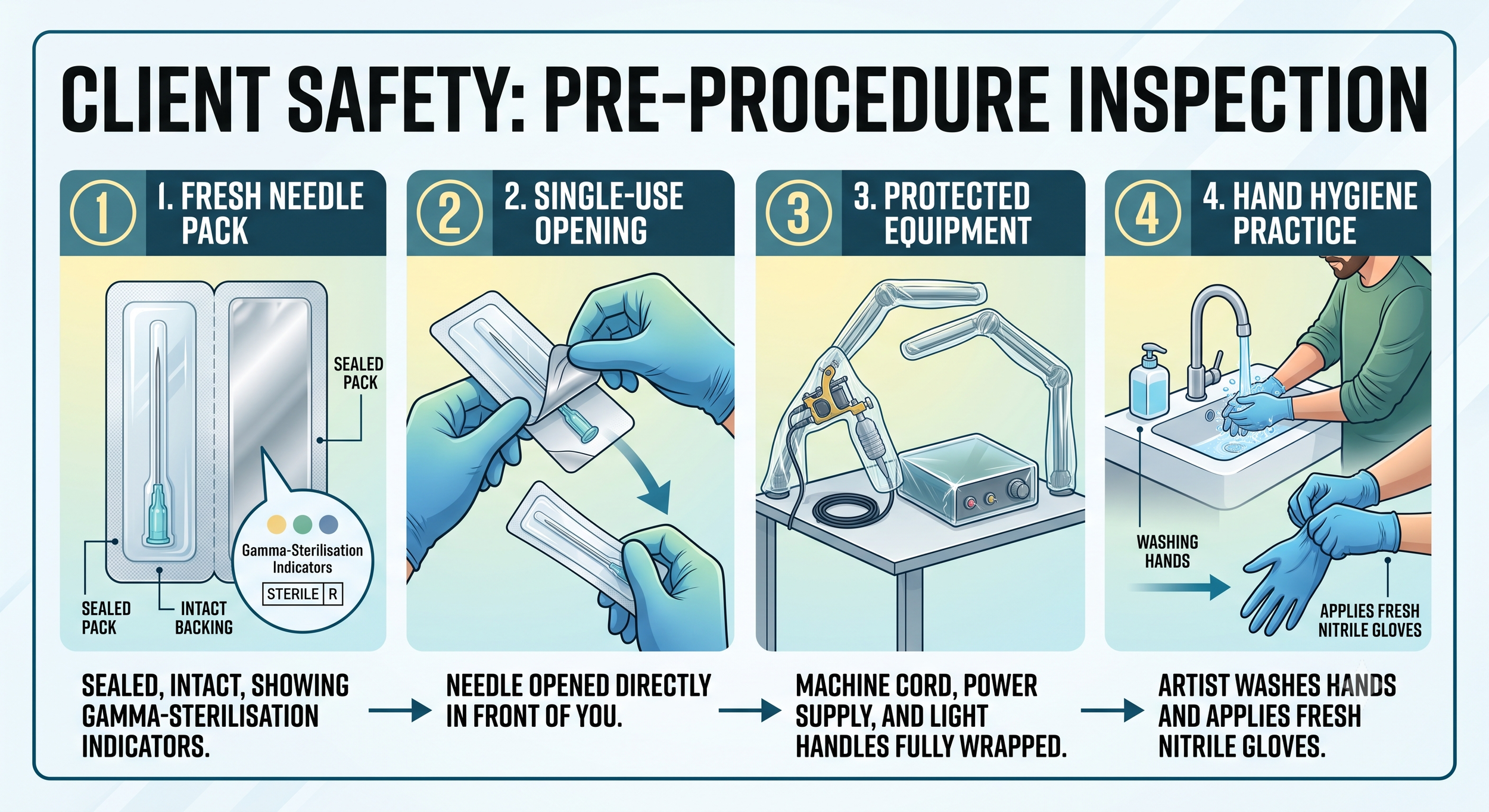
What to look for before your session begins:
Fresh Needle Sealed in Packaging: Your artist should open every single-needle cartridge directly in front of you from an intact, sterile blister pack containing a valid lot number and sterilisation indicator.
Sharps Disposal: At the end of the session, the used needle cartridge must be disposed of immediately into an approved yellow biohazard Sharps Container - never in a general rubbish bin.
Barrier Wraps: The machine, cord, power supply, and task light handles should be wrapped in fresh, single-use plastic barriers.
Hand Hygiene: Observe whether your artist washes their hands thoroughly using correct clinical technique before donning fresh nitrile gloves, and whether they change gloves immediately if they touch a non-sterile surface (like a phone or chair).
The URADIANT Commitment to Clinical Excellence
At URADIANT, our standard of care is shaped by a background in medical radiation therapy, where sterility, radiation safety, and infection control are second nature.
We do not view hygiene as a routine checklist; we treat it as an uncompromising clinical discipline:
100% Single-Use Consumables: Every needle cartridge, pigment cup, wiping pad, and barrier sleeve is opened fresh for your session and disposed of immediately into clinical waste.
Hospital-Grade Disinfection: All studio surfaces are disinfected between sessions using TGA-listed, hospital-grade germicidal solutions designed to eliminate bacterial, fungal, and viral pathogens.
Full Council Compliance: Our Paddington studio maintains full licensing and compliance with Sydney local health regulations, ensuring your peace of mind from the moment you step through our doors.
When you invest in your brows, lips, or scalp at URADIANT, you aren't just choosing high-level artistic precision - you are choosing an uncompromising commitment to your health and safety.
[ Explore our rituals : Nano Brows, Lip Blush & Dark Lip Neutralisation, SMP]
URADIANT SYDNEY | Visit our sanctuary, The Alchemy of Light, Art and Transformation
110D Boundary Street, Paddington NSW 2021. [Link: Get Directions]