The Adaptive Brow Technique: Why Rigid Templates Fail Natural Brow Density and Asymmetry
In cosmetic tattooing, one of the most widespread clinical errors is treating every eyebrow as an identical, flat surface. Inexperienced practitioners often rely on rigid, pre-drawn stencils—tattooing a uniform template of strokes from head to tail regardless of the client's existing hair growth.
The human face does not grow hair uniformly. Follicle density fluctuates significantly between the head, arch, and tail of a single eyebrow. Furthermore, nearly every individual exhibits natural bilateral asymmetry—where the left brow might be thick and unruly, while the right brow is sparse, thin, or patchy.
Applying a fixed stencil over variable hair growth creates an unnatural, overloaded tattoo. At URADIANT, we reject cookie-cutter stencils in favour of our proprietary Adaptive Brow technique—a diagnostic method designed to read individual follicle distribution, adapt stroke density in real time, and restore facial balance without unnecessary trauma.
The Flaw of the "Copy-Paste" Template
When an artist uses a static template, they implant the exact same number of strokes with identical spacing across the entire brow area.
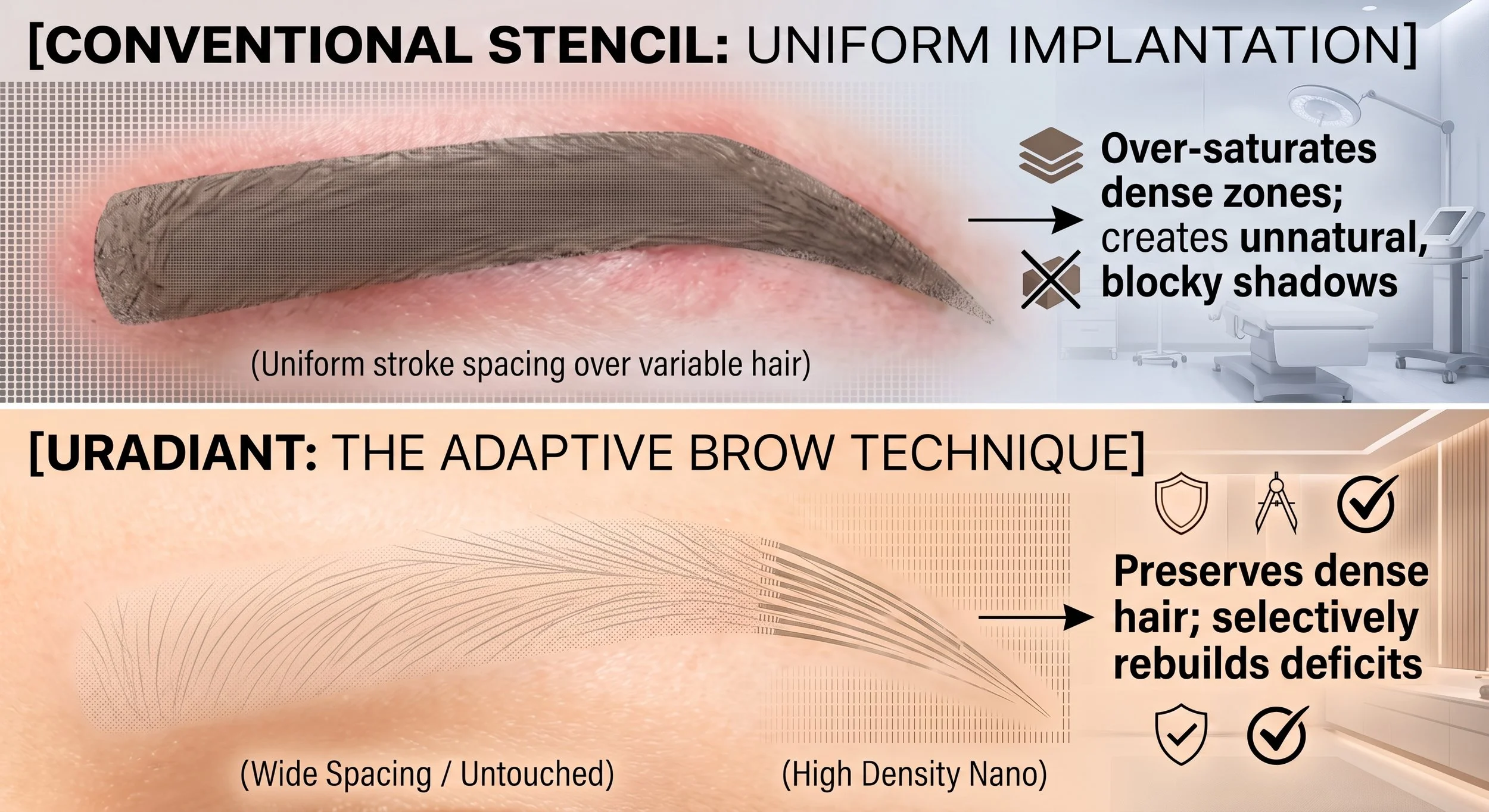
If a client already has a dense mid-body but a short, sparse tail, tattooing uniformly through the centre will oversaturate that area with pigment. Over 12 to 24 months, that dense centre turns into a muddy, dark block of ink, while the tail remains disconnected.
A rigid template attempts to change the brow to fit a drawing. The Adaptive Brow technique alters the drawing to solve the client's specific biological deficit.
The Mechanics of the Adaptive Brow Technique
The foundation of the Adaptive Brow method lies in calculating dynamic spatial frequency—adjusting the distance between implanted Nano strokes based on the existing follicle count in each specific square millimetre of skin.
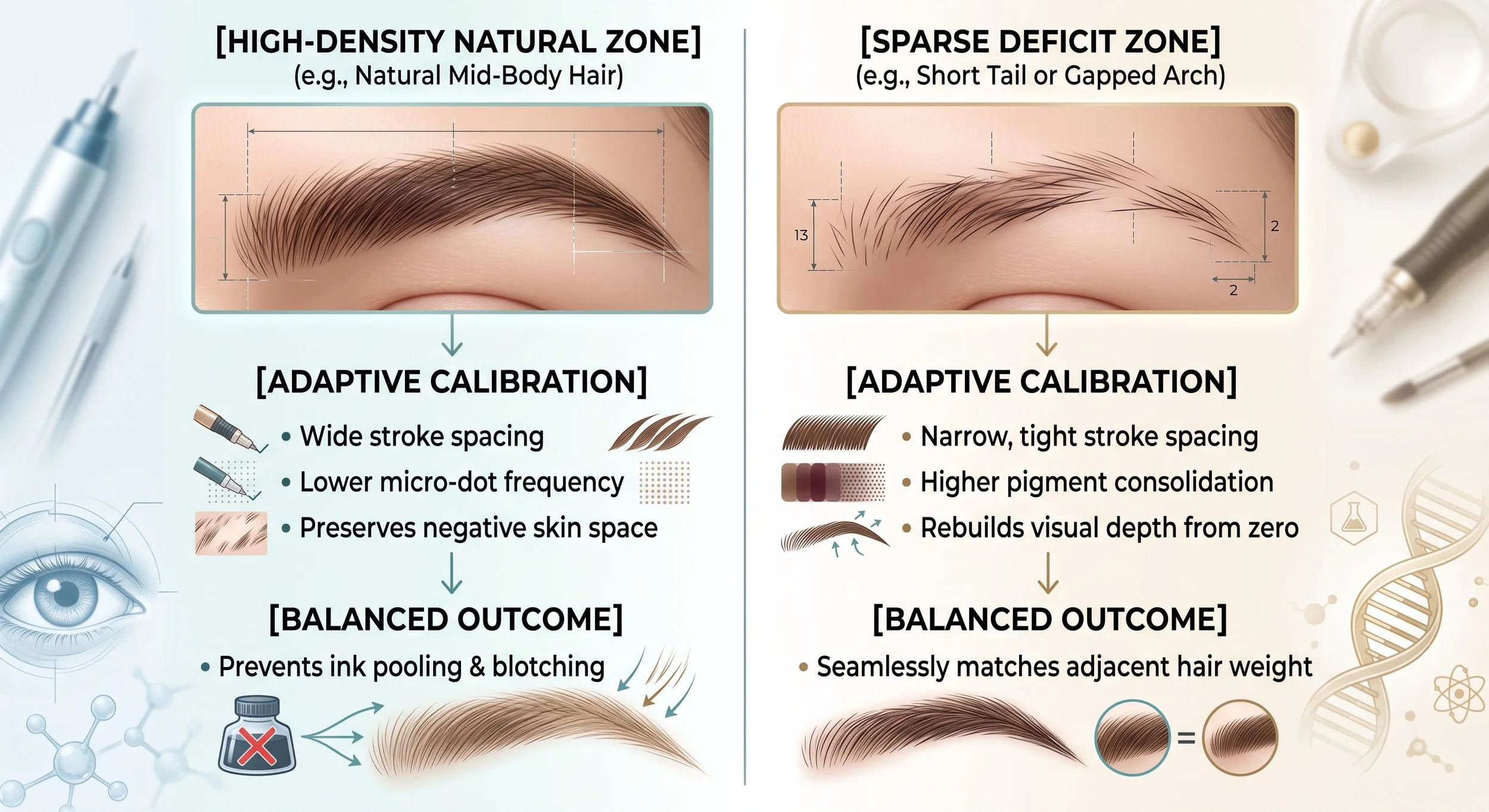
1. Real-Time Density Calibration
Dense Hair Zones: In areas where the client already has ample natural hair, adding standard hairstrokes causes visual congestion. Under our adaptive protocol, we widen the space between Nano strokes or leave the area untouched. This preserves the natural negative space of the skin and prevents the brows from appearing artificially heavy.
Low-Density / Bare Zones: In areas where hair is missing entirely (such as a sparse bulb or short tail), the visual weight drops. Here, the artist adapts by placing single-needle strokes closer together, building multidimensional depth so the bare skin catches up to the volume of the natural hair.
2. Managing Left-to-Right Asymmetry
Because no client has identical hair density on both sides of their face, the left and right brows can never be treated with the same formula. One side may require 70% reconstruction, while the opposing side requires only a 20% partial adjustment.
The Adaptive Brow technique assesses each brow independently, ensuring both sides achieve visual symmetry without overloading the fuller side with unnecessary ink.
Targeted Solutions: What the Adaptive Technique Resolves
Rather than subjecting the entire brow to uniform needle passes, the Adaptive Brow technique dynamically calibrates stroke caliber (thickness) and spacing across different zones:
1. The Truncated (Short) Tail Many clients possess full, healthy hair through the front and body, but their brows terminate abruptly before reaching the temple.
The Adaptive Fix: Instead of heavily tattooing the entire brow, we apply only ultra-fine, feather-light transitional strokes with wide gaps through the existing body to maintain a cohesive flow. We then concentrate structured single-needle Nano strokes along the missing tail, extending the brow length to gracefully frame the lateral orbital bone and lift the eye area.
2. The Broken or Asymmetrical Arch Habitual plucking or localized trauma often leaves a missing patch or notch along the upper archline.
The Adaptive Fix: We place whisper-thin, widely spaced micro-threads through the surrounding healthy hair to ensure smooth continuity, while concentrating denser, precisely angled micro-strokes directly into the deficit to rebuild structural arch volume without over-saturating the periphery.
3. Sparse Bulb (Brow Head) Correction When the inner head of the brow is thin or blunt, rigid templates make the front look harsh and stamped-on.
The Adaptive Fix: We introduce ultra-fine, airy, fanned micro-strokes with generous negative space between them. These light strokes gradually increase in density as they merge into the mid-body, creating a soft, natural gradient rather than an abrupt border.
The URADIANT Philosophy: Calibrated Density & Tissue Conservation
At URADIANT, every procedure begins by answering a fundamental clinical question: "Where do we need structural support, and where do we need only delicate, airy detail?"
Calibrated Stroke Caliber & Negative Space: In areas with rich natural hair, we use a lighter hand and wider spacing to prevent ink pooling and long-term pigment blur. In sparse zones, we tighten the spacing and layer the strokes to build true three-dimensional depth.
1:1 Chromatic Integration: When adapting between dense and sparse zones, our European-certified Hybrid pigments are custom-blended to match your natural hair tone with absolute precision, ensuring that the new strokes blend invisibly across both light and dense areas.
Single-Needle Machine Control: Using high-precision digital motors rather than manual cutting blades allows us to alter stroke weight and dot frequency on the fly with zero slicing trauma, delivering an effortless heal and true-to-tone longevity.
True mastery in cosmetic tattooing is not about forcing a stencil onto a face—it is about adapting your stroke weight, frequency, and spacing to honour the unique anatomy in front of you.
Scientific References
Zhen, X., et al. (2020). The effects of needle insertion parameters on skin injury and wound closure. Journal of the Mechanical Behavior of Biomedical Materials, 103, 103588. (Demonstrates the clinical benefits of minimal needle intervention to conserve healthy dermal tissue).
Baranska, A., et al. (2018). Unveiling skin macrophage dynamics explains tattoo persistence. Journal of Experimental Medicine, 215(4), 1115–1133. (Details dermal tissue recovery, cellular encapsulation, and localized pigment retention).
Sepehri, S., & Serup, J. (2015). Tattoo Pigments: Chemistry, Toxicology and Photochemical Fate in the Skin.Current Problems in Dermatology, 48, 28–35. (Covers pigment saturation limits, spatial distribution, and optical tone density).
[ Explore our rituals : Nano Brows, Lip Blush & Dark Lip Neutralisation, SMP]
URADIANT SYDNEY | Visit our sanctuary, The Alchemy of Light, Art and Transformation
110D Boundary Street, Paddington NSW 2021. [Link: Get Directions]